

Greetings all. Excited to share with you a conversation I had earlier today with Rep. Greg Meeks, Ranking Member of the House Foreign Affairs Committee. Ranking Member Meeks has been at the center of some of our most important Congressional debates this year, and will be a new critical face of American foreign policy to the world after we take back the House this November.
I asked him to come by during the early days of the House summer recess to share his reflections on some of the biggest challenges our country faces as Trump has taken a wrecking ball to the world and our global standing. A video recording is above and a full rough transcript is below.
Let me now share the transcript of two portions of our discussion:
Simon Rosenberg: I wanted you to come on because you’re at the center of so many things that matter so much to all of us. And I just wanted to take this time, during recess, to let you reflect perhaps on the great battles of the last year and a half — on Iran, Russia, and the tariffs. Where do you think we are as a country? Where do you think we are as a party? What do we need to do now to make sure we close strong in this Congress and get ready, when we’re back in power, to start reasserting the old American way on the foreign stage?
Rep. Greg Meeks: I think we’ve got to go back to where we were — you know, “don’t do stupid things,” as Barack Obama put it. The world is smaller than it’s ever been. We’ve got to make sure we’re working with our friends and allies, treating them as friends and allies, and understanding who our adversaries are — but working collectively so we have the influence to change the direction some of our adversaries would otherwise move in. What’s happened over the last year, year and a half, is a separation from many of our allies. They question who we are, they question our values. It used to be that wasn’t disputed — they wanted to follow us, we utilized our values like democracy. Now they see what’s taking place and they’re wondering. What’s going on is we’re just trying to utilize raw power. I’ll tell you, Simon — one of the things I recall, when I first got elected to Congress in 1998 — I’ve been here a long time — is a conversation I had with Bill Clinton. I asked him what surprised him most, leaving office, compared to what he’d anticipated when he entered office. He brought it to foreign affairs, and he said he found that we could do more by working with, talking to, and using soft power than by using our military might. We have that military might, and people know we have it — but using soft power made all the difference.
What’s taken place since Trump became president is that we’ve basically eliminated our soft power. We decimated the State Department and all the experts there. We got rid of USAID. So I think we’ve got to get back to the path Democrats have followed — USAID was something Democrats, John F. Kennedy put forth in the ‘60s, and we were always moving forward in that direction. We’ve got to go back to being the party that’s an example for others to follow. I think we’ve lost that road right now, and we’ve got to get that credibility back with our friends and allies.
Here is Ranking Member Meeks on the current Russia sanctions bill winding its way through the Senate. I agree with every word of what he says here:
Simon Rosenberg: Talk a little bit about Russia. This is something you've been very focused on, a major undertaking for you. You got something passed in the House; the Senate looks like it's moving in a different direction. Where do you think this goes in this Congress and in the months to come?
Rep. Greg Meeks: Look — I know it seems like there's some momentum on the so-called Graham-Blumenthal bill, which is problematic to me when you look at its essence. Russia clearly thought they could go into Ukraine and defeat it within a week or two. Five years down the road, the war is still going on. There are sanctions that need to be placed on Russia. We should have been, earlier, aiding the Ukrainians in a greater way, giving them more of what they needed — but they have shown ingenuity on their own.
So I'm concerned, Simon, when I look at the so-called Graham-Blumenthal bill, which is supposed to put sanctions on Russia. Because when you look at it — number one, Senator Graham did not want to do anything Donald Trump did not want. So what did he put in this bill? The sanctions that would be imposed on Russia are left to the president's discretion. And we know the president has decided he doesn't want to put any sanctions on Russia —– he's been blocking them. So why have a sanctions bill where the discretion is the president's?
Secondly, I'm against tariffs, because tariffs are a tax that the American people will pay for. I put in and passed a bill that stopped Trump from using tariffs with reference to Mexico and Canada, and the courts later agreed with me that only Congress has the ability to determine tariffs in an emergency situation like the one the president was declaring. So what does this bill do? It puts tariffs on our friends and allies — giving Trump a way around the Supreme Court's ruling and the Constitutional principle that only Congress can do that. Now he can place tariffs on our friends and allies — not necessarily on Russia, but on our allies. It just doesn't make sense.And I know — the tragic death of Senator Graham, I know there are many Democrats and Republicans who want to stand strong with Ukraine. But we've got to read the label, and the label of this bill [is] really an end-around for Donald Trump — allowing him not to issue sanctions on Russia, while letting him impose tariffs on our friends and allies.
We can and must do better than this bill as it’s currently constructed. Hopefully we can get that done when Congress returns in September. As a reminder Ranking Member Meeks was the lead Democrat on the Ukraine Support Act, a bill which rallied for Ukraine, that passed the House through a discharge position this past June. It was a major achievement. Here is the statement his team put out following passage:
Washington, DC -- Representatives Gregory W. Meeks, Ranking Member of the House Foreign Affairs Committee; Steny H. Hoyer (MD-05); Brian Fitzpatrick (PA-01) and Marcy Kaptur (OH-09), Co-Chairs of the Congressional Ukraine Caucus; Bill Keating (MA-09), Ranking Member of the Europe Subcommittee; Don Bacon (NE-02); and Kevin Kiley (CA-03) today issued the following statement on the passage of Ranking Member Meeks' bipartisan Ukraine Support Act, the first comprehensive legislation to support Ukraine and impose sanctions on Russia to pass the House in the 119th Congress.
“Inaction on Ukraine ends now. Today’s bipartisan vote to pass the Ukraine Support Act demonstrates that the House stands with the Ukrainian people and that we will hold the criminal Russian regime accountable for its illegal war. I thank my Democratic colleagues and my Republican colleagues who’ve co-sponsored this bill, without whom this vote would not have been possible. And I especially thank the Ukrainian American community and all those Americans standing with Ukraine, for their tireless efforts to see this bill move forward. Now the Senate must follow suit, and work with our bipartisan group in the House to deliver the most comprehensive package possible to the President’s desk for his immediate signature,” said Ranking Member Meeks.
As we discuss in our interview I think one of the most important things Democrats can do when back in power next year will be to show the world pro-democracy Americans have returned to power. Leading that effort will be Ranking Member Meeks, and I am pleased he was able to drop by today to share his thoughts with us. We didn’t have time to get into everything in front of us now, including our policy towards Israel and Trump’s ridiculous “Board of Peace.” That will come next time.
Keep working hard all. We have a country to save, and elections to win all across the country, together - Simon
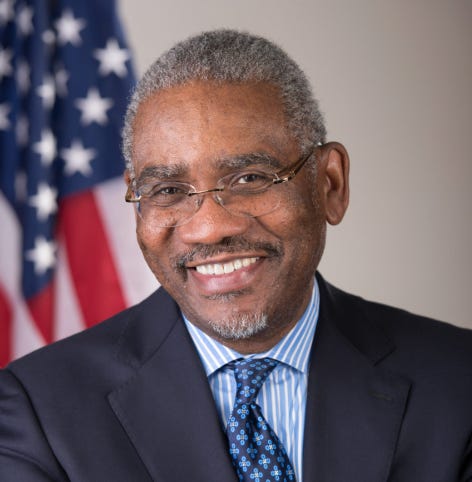
Biography - Representative Gregory Meeks (NY-05), Ranking Member of the House Committee on Foreign Affairs
From public housing to the nation’s Capital, Gregory Weldon Meeks has lived a true American success story. Known for his compassionate and tenacious representation of his constituents, and his coalition-building skills, Meeks proudly serves the constituents of New York’s Fifth Congressional District in the U.S. House of Representatives.
Congressman Meeks’ compassion and ability to collaborate are rooted in his upbringing. His family ventured north during the Great Migration from Rock Hill, South Carolina, eventually settling in East Harlem. He grew up in a public housing project and knew in his early years that he wanted to be a lawyer. He was inspired by a mother and father who worked hard to ensure that their children would have opportunities for advancement that they never did. Meeks’ parents passed on to him a profound sense of social justice, commitment to community, and willingness to extend a helping hand to those in need.
He carried these values with him to Adelphi University where he earned a bachelor’s degree in history. At Howard University Law School, Meeks embraced the jurisprudence of his idol, Thurgood Marshall, and of Charles Hamilton Houston. In the years to follow, Congressman Meeks worked as a Queens County Assistant District Attorney, a prosecutor for a special anti-narcotics taskforce, and chief administrative judge for New York State’s worker compensation system. In 1992, he was elected to the New York State Assembly, where he served until 1998, when he won a special election to represent the Fifth Congressional District of New York.
Congressman Gregory W. Meeks, now in his thirteenth term, has devoted his energy and skill to serving one of the most diverse constituencies in the nation. His efforts on behalf of his district, New York City and State, and the nation as a whole have earned Rep. Meeks the respect of his constituents, New Yorkers, and Democrats and Republicans alike. He is known for being an effective, principled, and common sense leader. As a fervent supporter of the Affordable Care Act enacted under President Obama, Congressman Meeks believes that it should be enhanced. Congressman Meeks is part of the forward-thinking, pro-growth Democratic members who comprise the New Democrat Coalition (NDC), the largest ideological caucus in Congress. He co-chairs the NDCC Trade Task Force.
Congressman Meeks is the Ranking Member of the House Foreign Affairs Committee. He formerly served as the Chairman of the House Foreign Affairs Committee. Rep. Meeks was the first Black Member of Congress to serve as Chair of that committee in the 117th Congress. Meeks is a multilateralist with decades of experience in foreign policy. He believes that the United States should build coalitions around our interests and work with other countries to build a stable and prosperous future.
He is a senior member of the House Financial Services Committee, where he served as the Chairman of the Subcommittee on Consumer Protection and Financial Institutions which oversees all financial regulators such as, FDIC, Federal Reserve and all matters pertaining to consumer credit and the stability of the banking system. Rep. Meeks previously served as a Dodd-Frank conferee. Key provisions in the Wall Street reform law – including its stress testing requirement, the creation of the Office of Minority and Women Inclusion at the financial regulatory agencies, and the requirement that U.S. public companies who use natural resources to report their due diligence in stamping out conflict minerals – were co-authored by Congressman Meeks and remain in the law today.
Congressman Meeks is a member of the Allen AME Church in St. Albans, New York and a proud member of Alpha Phi Alpha Fraternity, Inc. As a huge sports fan, Meeks enjoys watching the New York Knicks, the New York Giants, and the New York Mets. He is married to Simone-Marie Meeks. He has three daughters – Ebony, Aja, and Nia-Aiyana and four granddaughters and one grandson.
Learn more about Representative Meeks here.
Transcript - Simon Rosenberg Interviews Rep. Greg Meeks
Simon Rosenberg: Welcome, everyone. Simon Rosenberg, Hopium Chronicles, back with another special event today. Joining me is an old friend, Congressman Greg Meeks, who’s the Ranking Member on the Foreign Affairs Committee in the House. Welcome, Congressman.
Rep. Greg Meeks: Good to be with you, Simon.
Simon Rosenberg: Listen, I wanted you to come on because you’re at the center of so many things that matter so much to all of us. And I just wanted to take this time, during recess, to let you reflect perhaps on the great battles of the last year and a half — on Iran, Russia, and the tariffs. Where do you think we are as a country? Where do you think we are as a party? What do we need to do now to make sure we close strong in this Congress and get ready, when we’re back in power, to start reasserting the old American way on the foreign stage?
Rep. Greg Meeks: I think we’ve got to go back to where we were — you know, “don’t do stupid things,” as Barack Obama put it. The world is smaller than it’s ever been. We’ve got to make sure we’re working with our friends and allies, treating them as friends and allies, and understanding who our adversaries are — but working collectively so we have the influence to change the direction some of our adversaries would otherwise move in.
What’s happened over the last year, year and a half, is a separation from many of our allies. They question who we are, they question our values. It used to be that wasn’t disputed — they wanted to follow us, we utilized our values like democracy. Now they see what’s taking place and they’re wondering what’s going on…
I’ll tell you, Simon — one of the things I recall, when I first got elected to Congress in 1998 — I’ve been here a long time — is a conversation I had with Bill Clinton. I asked him what surprised him most leaving office, compared to what he’d anticipated when he entered office. And he brought up foreign affairs, and he said he found that we could do more by working with, talking to, and using soft power than by using our military might. We have that military might, and people know we have it — but using soft power made all the difference.
And what’s taken place since Trump has become the president is that we’ve basically eliminated our soft power. We decimated the State Department and all the experts there. We got rid of USAID. So I think we’ve got to get back to the path Democrats have followed — USAID was something Democrats, John F. Kennedy, put forth in the ‘60s, and we were always moving forward in that direction. We’ve got to go back to being the party that’s an example for others to follow. I think we’ve lost that road right now, and we’ve got to get that credibility back with our friends and allies.
Simon Rosenberg: So let’s say, in the next few days, the news reports are true that Trump is going to agree with our Gulf Arab friends to allow Iran and Oman to control the Strait — essentially certifying, for now, Iran in a place of far greater regional significance than before. How are you thinking about how this plays out over the next few years? Trump did this without the approval of Congress — an illegal war without authorization. He’s spent extraordinary amounts of money, done enormous damage to our prestige around the world, and now put us in a very difficult geopolitical position. How do you think about this over the next few years?
Rep. Greg Meeks: The way I think about it is, unfortunately, we’ve got to go back to where we were when we passed the JCPOA. One of the things significant about that — ask yourself, are we better off now than when we entered the JCPOA? When we had the JCPOA, we had our allies with us, and even some of our adversaries — Russia and China were part of it. We had a real focus on the nuclear weapons Iran was pursuing. I spent a lot of time traveling to Geneva to talk to the IAEA (International Atomic Energy Agency) to find out what they could observe about whether Iran was cheating or not, and I was told we were in the best position we’d ever been in for observing Iran’s activities — never had that happened before. So we ripped that up.
We’re in a better place when we’re using soft power. We need to get back there with our allies in the situation we’re currently in. I talk to our GCC countries, and they tell me they wish the president of the United States would at least listen to them, take them seriously — they’re often overlooked with the things and recommendations they’re making to the president.
So we as a party need to make sure we go back to talking, listening, and working collectively. Does that mean we get everything we want? No, it does not — like the compromise that had to be made in the JCPOA. But we’ve got to start from that principle. It puts pressure on the Iranians and others who don’t share our values — pressure from our values, from what would lead. And we’ve lost that.
Simon Rosenberg: Seems like it’s going to be expensive — we’re going to have to replenish all the military hardware, the weapons we’ve used, the missiles fired, the bombs dropped. We’re running low, which is weakening us around the world. And the Iranians are going to demand some extraordinary amount of money to help rebuild their country. Do you think the American people are ready to pony up hundreds of billions — or trillions — of dollars to pay for what comes out of this war?
Rep. Greg Meeks: No — and that’s why I say America can’t do it alone. That’s the problem with the Trump policy — it’s “America alone.” You say “America first,” but it’s America alone. We need friends and allies, because this affects the entire world. Many of our GCC countries are ready to step up — if their countries and economies aren’t completely destroyed as a result of this war — and some of our other allies around the world will put up as well, so we can do this collectively. It won’t have to be America by itself, or Israel by itself — it’s all of us working together. This is what soft power, democracy, diplomacy means.
When I became chair of the committee, I thought of the “three D’s” — development, diplomacy, and democracy. I think those are things we’ve got to return to in our foreign policy, which we’ve deserted over the last year and a half. We need to go back, talk, work with allies. Collectively, we can make this earth a better and safer place.
Simon Rosenberg: Talk a little bit about Russia — this is something you’ve been very focused on, a major undertaking for you. You got something passed in the House; the Senate looks like it’s moving in a different direction. Where do you think this goes in this Congress and in the months to come?
Rep. Greg Meeks: Well, look — I know it seems like there’s some momentum on the so-called Graham-Blumenthal bill, which is problematic to me. When you look at its essence — Russia clearly thought they could go into Ukraine and defeat it within a week or two; five years down the road, the war is still going on. There are sanctions that need to be placed on Russia. We should have been aiding the Ukrainians in a greater way, earlier, giving them more of what they needed — though they’ve shown a lot of ingenuity on their own.
I’m concerned about the Graham-Blumenthal bill, which is supposed to put sanctions on Russia. Why? Because when you look at it — number one, Senator Graham did not want to do anything Donald Trump didn’t want. So what’s in this bill? The sanctions that would be imposed on Russia are left to the president’s discretion. And we know the president has decided he doesn’t want to put any sanctions on Russia — he’s been blocking them. So why have a sanctions bill where the discretion is entirely the president’s?
Secondly, I’m against tariffs, because tariffs are a tax that the American people end up paying. I put in and passed a bill that stopped Trump from using tariffs with reference to Mexico and Canada, and the courts later agreed with me that only Congress has the ability to determine tariffs in an emergency situation like the one the president was declaring. So what does this bill do? It puts tariffs on our friends and allies — giving Trump a way around the Supreme Court’s ruling and the Constitutional principle that only Congress can do that. Now he can place tariffs on our friends and allies — not necessarily on Russia, but on our allies. It just doesn’t make sense.
And I know — the tragic death of Senator Graham, I know there are many Democrats and Republicans who want to stand strong with Ukraine. But we’ve got to read the label, and the label of this bill [is] really an end-around for Donald Trump — allowing him not to issue sanctions on Russia, while letting him impose tariffs on our friends and allies.
Simon Rosenberg: Yeah, it’s really extraordinary. I know Zelensky came and lobbied, and a lot of reluctant Democrats got on board because of his personal plea, which I think was very powerful last week. But let me get to one other thing before I let you go — the likely scenario is that the House flips back to Democratic control. We know anything can happen in this crazy business, but there’s a real likelihood you’ll be chairman of the committee again. How are you thinking about your agenda — about traveling to foreign capitals to wave the flag of democracy, the “old America” that people knew? You leading delegations to a handful of capitals next year, after we’re back in power, could be symbolically really important. I know we don’t want to get ahead of ourselves — we still have to win this election, and Hopium, my community, is very focused on that; we’ve raised millions of dollars for House Red-to-Blue candidates, and we’re working really hard. But how are you thinking about the symbolic part of the job, and some of the agenda you might pursue next year?
Rep. Greg Meeks: Yeah, we have to be present. It’s almost like knocking down two birds with one stone — countries want us, they want to see members of Congress, they want to talk to us. Traveling and meeting with them shows a sense of respect for them and their governments as partners with us. So traveling becomes tremendously important, especially with our friends and allies — and it’s even important, sometimes, to visit some of our adversaries, to let them know where we stand and be straight with them too.
It also serves the purpose of learning ourselves — you understand more about what’s taking place in another part of the world, and the best way to do that is to travel there. When we do, we want to meet with elected officials and business folks and so on, but you also want to walk and talk to people. On my CODELs, we make sure we’re talking to individuals in restaurants, taxi drivers, the people cleaning hotel rooms — talking to average, everyday people, getting a feel for them, for the culture of the country, for what their needs are. They feel respected, we feel respected, and we’re learning more about each other — and that makes [a difference].
You go back 50, 60 years, and people thought the Atlantic and Pacific just protected America, that we could be there by ourselves, basically. That’s not the case. We’re all interconnected. As we saw during COVID — if there’s a virus in one part of the world, it’s going to affect our part of the world. If there’s a financial crisis in one part of the world, it’s going to affect other parts. We’re all really interconnected, and understanding and working together in that regard is tremendously important — and it’s something I’ll be doing, and encouraging every member of Congress to do once we take the majority back.
Simon Rosenberg: Yeah, I know — I love that, and the way you talk about this, because I think people are desperate to see America, the Democratic — and again, around the world — to not believe that we’ve yielded to this oligarchy and this sort of right-wing politics that Trump represents. I do hope you’ll have the time — and it’s going to be very busy next year when we’re back in power — but that you’ll be able to make time and maybe do some trips with your colleagues, Adam Smith and Jim Himes, who are going to be great partners for you in steering this national security direction of our party again. Because I do think the opportunity you’re going to have, Congressman — or ranking member, I should say, or the chairman — is that Democrats need to have a foreign policy again that’s clear to people. We need to make it very clear that we stand with Ukraine and not with Russia, and that we want peace in the Middle East and the world to work together. All the things you’ve been talking about today — I think it’s really important that we not let these things be seen as secondary as we take back power. They’re primary, and we need to [treat them that way].
And so, whatever we can do here in the Hopium community to help you achieve your agenda — I told your team that our community made tens of thousands of phone calls promoting your Russia bill. We made tens of thousands of calls on tariffs too. We’ve been very active in pushing your agenda, frankly, on Capitol Hill, and we’re going to continue to do that because we know you’re leading us in the right direction.
Rep. Greg Meeks: Let me thank you for that. And let me also say why it’s important that we do that, because it helps us domestically too. We talk about rising costs for food, gas, other items — the cost of living. When we’re working better with other countries, when we’re making sure there’s that kind of dialogue, it brings down prices. Right now, while the Strait of Hormuz is closed, it doesn’t just affect oil prices — it affects food prices too. Our farmers have been complaining because fertilizer can’t get through the Strait. So working cooperatively with allies and friends makes us safer, protects us domestically and internationally, and brings down the cost of living for average, everyday Americans.
That’s why this is important. We’ve got to explain it to the American people, too — that foreign policy is not irrelevant, that we shouldn’t just not be involved in foreign policy. That’s not the way to go in the time we currently live in. And I thank you for all you’re doing to get that message across.
Simon Rosenberg: Listen, I think one of the things people are going to want, when Leader Jeffries becomes Speaker, is to see a muscular foreign policy — to see us returning to leadership in the world. I know we have to take care of kitchen-table issues and fight corruption, but there’s also this part of us — waving the flag around the world — that I think is going to be really important for us, and perhaps one of the most important jobs for us in the next Congress. So let us know what we can do to help you, my old friend. Congratulations on the Knicks, by the way.
Rep. Greg Meeks: Thank you — it was a huge, unbelievable season for the ages. We go back as New York sports fans — I was at the ‘86 [World Series] Game 6, the Buckner game. I was there. We went through it for the Mets — that was a year like the Knicks, right? That special year — they don’t come along very often, so we got to enjoy it while we can. Fifty-three years for the Knicks, baby. I told you earlier, I went to games during the ‘73 season with my dad — I was a young, young guy.
Simon Rosenberg: Listen, let us know what we can do to help you. If there’s ever anything you want to come on here and talk to our community about, please do. We’re trying to make sure Democrats don’t just accept that the only thing the American people want to hear about is kitchen-table issues — there are other matters of equal importance, and we need to lead across more than one domain at a time. I’m just grateful for your many years of service, and frankly for your incredible leadership in recent years. I feel like you’re ready for this next opportunity, and you’re going to kick ass for us next year. Excited to be on your team, Congressman.
Rep. Greg Meeks: Thank you. And thank you for everything that you do.
Simon Rosenberg: Thanks, everybody. If you liked this interview today — and I’m sure you did — hit like so more people will see it, and share it with others. Greg Meeks is an old friend, he’s done a remarkable job, I’m really proud of him. We need him to be successful — we’re going to be there by his side every day, starting in early January next year. Thanks, everybody. Take care. Remember, we have a country to save and elections all across the country to win together. Thank you.


