

Afternoon everyone. Yesterday I sat down with former Washington state Governor Jay Inslee. A video recording is above and a transcript is below.
Governor Inslee co-chairs The Accountability Campaign at Climate Power, a strategic communications organization focused on winning the politics of climate. Here’s a bit more about Climate Power:
We’re educating Americans about our climate progress, highlighting how clean energy investments benefit local communities, and holding Big Oil accountable for polluting our air and water. We use data-backed messages to pave a path for bold action and shine a light on the price of ignoring the climate crisis would cost our health, economy, and future generations.
I asked former Governor Inslee to come join us to talk about the opportunity rising electricity prices offers Democrats to make the case for a cleaner and cheaper energy future next year; about Trump’s designs on Venezuelan oil, his love of petro-dictators, and his dangerous and retrograde views on climate change; and how we are ceding the future to China and others by stepping back from attempting to win the clean technology race.
Here is how Gov. Inslee sees the opportunity in front of us in 2026:
this is a magic moment, a magic opportunity for Democratic leaders who can really seize the initiative on the issue of clean energy and climate change at the same time. In moments like that, when you have an opportunity, you’ve got to seize the moment politically. This is the moment where the fact that Americans have had a belly full of Donald Trump giving them higher electrical prices. And electrical costs for Americans right now is the new eggs. So he’s talked about egg prices going up. Well, we’re talking about electrical prices going up on his watch. And he has made those prices worse because he has denied Americans access to the cheapest electrical generating source, which is renewable energy, which is cheaper than coal right now in 95% of the country. He has taken that away from Americans. And one thing Americans don’t like is when a president shoves higher prices down their throats… and that’s what this guy is doing. And we have to shove it down his throat. And all the Republicans are going over the cliff with him because instead of giving Americans cheaper electricity, he is denying them access to those cheaper sources of energy. Big time. He’s canceled 332 clean energy projects. That’s enough for 16 million American homes. And it’s driven up prices that have now gone up 13%… three times the rate of inflation in the rest of the economy.
So the reason this is a magic moment is that Americans are suffering at their pocketbook, but as a result, there’s also an opportunity to fight climate change because they’re suffering because of these catastrophic climate events as well [as we are seeing in Washington state right now]……
In our conversation I mention some data from this week’s Economist/YouGov poll about how important climate change is to Democratic voters. Here it is:
Most Important Issue, 2024 Harris Voters (Democrats), 12/15/25:
Inflation 22%
Civil Rights/Civil Liberties 21%
Health Care 18%
Climate Change/Environment 14%
Jobs/Economy 10%
For those who want to go a bit deeper into the data Gov. Inslee discusses see Climate Power’s new report, Trump’s Unfolding Energy Crisis. Here’s a link to my December, 2016 essay in US News and World Reports that we discuss -The Pernicious Politics of Oil.
As I wrote today while we are spending a lot of time talking about the power and influence of the tech bros, we need to be spending much more time talking about the power and influence of the petro bros…..
Enjoy this conversation with one of America’s most accomplished climate and clean tech warriors and keep working hard everyone - Simon
Rosenberg-Inslee Transcript
Simon Rosenberg:
Hey, everybody. Welcome. Simon Rosenberg, Hopium Chronicles, back with another great event. Today I’m being joined by an old and dear friend, former Washington State Governor Jay Inslee. Welcome, Governor.
Jay Inslee:
Welcome. Great to see you. We go back to the 90s together.
Simon Rosenberg:
[Laughs.] Well, listen, it’s great to see you. I just want to, first of all, congratulate you for having been in this business for so long and been a congressman and been a governor and served. You’re staying in the fight. The fight that you’re now leading is with a group called Climate Power. You’re trying to make sure that we keep our political leaders’ feet to the fire on the climate emergency and the opportunities that we have to build a clean energy economy and make the energy transition… just very grateful for your commitment to this battle. It’s one that I think is really central to our future, but it hasn’t really been central to our politics as much as it needs to be, I think. So thank you for staying in the fight, and talk to us about what you’re doing and what you see now, because certainly I think, we know from these two elections in New Jersey and in Virginia that the issues around utility price increases have really become a major voting issue now for voters. So just give us your sense of the lay of the land, Governor.
Jay Inslee:
Well, I guess, a little contrary position. I’m not sure that we need to hold politicians’ feet to the fire. We have to keep their eyes focused on the light. And this is a moment of a lot of light. I love the Hopium name because I actually think there’s more hope in abundant amounts right now than maybe for 10 or 20 years, because this is a magic moment, a magic opportunity for Democratic leaders who can really seize the initiative on the issue of clean energy and climate change at the same time. In moments like that, when you have an opportunity, you’ve got to seize the moment politically. This is the moment where the fact that Americans have had a belly full of Donald Trump giving them higher electrical prices. And electrical costs for Americans right now is the new eggs. So he’s talked about egg prices going up. Well, we’re talking about electrical prices going up on his watch. And he has made those prices worse because he has denied Americans access to the cheapest electrical generating source, which is renewable energy, which is cheaper than coal right now in 95% of the country. He has taken that away from Americans. And one thing Americans don’t like is when a president shoves higher prices down their throats… and that’s what this guy is doing. And we had to shove it down his throat. And all the Republicans are going over the cliff with him because instead of giving Americans cheaper electricity, he is denying them access to those cheaper sources of energy. Big time. He’s canceled 332 clean energy projects. That’s enough for 16 million American homes. And it’s driven up prices that have now gone up 13%… three times the rate of inflation in the rest of the economy. So the reason this is a magic moment is that Americans are suffering at their pocketbook, but as a result, there’s also an opportunity to fight climate change because they’re suffering because of these catastrophic climate events as well. You know, I think of Stehiken, where we had fires last summer and almost burned down the town of Stehiken. And now we have these floods because all the water comes down—all this flood, the mud comes down because the trees are gone. And it’s destroyed a good part of the town. So this is a great moment. We ought to seize it. Democrats should be aggressive and optimistic. So I’m looking forward to next November.
Simon Rosenberg:
Talk a little bit about the project that you’re personally involved in at Climate Power. I know you’ve set up a new war room, I think, right, to help publicly be more aggressive in public communications around this.
Jay Inslee:
Yeah, obviously, a really important part of this battle is communication because right now Trump has the megaphone in the White House calling this a climate hoax. He’s now trying to strip away virtually every environmental law that protects our health that he can get his hands on. As I’ve indicated, he has canceled 332 clean energy projects. So communicating to Americans the damage that is being done to them by him is a very important part of democracy. So the Climate Power project I’m involved in is to hold him accountable and importantly, hold the Republicans in Congress accountable. You know, you think of the congressperson in the 6th District in Tucson, Arizona. He’s voted to cancel half a dozen job projects with hundreds of jobs in a place where the temperature, when I was down there in the last election cycle, I think it was 118 degrees. And so he has voted to go over the cliff, to deny people in Arizona jobs, to deny them cheaper energy, and to expose them to the ravages of climate change that is cooking that state. Well, this is going to hold him accountable and hold people accountable across the United States who refuse to respect science and economics. And people are responding to this. I’ll tell you, you know, the election results—I know you’ve talked about this in your podcast—I mean, these are smashing amounts of people in Virginia, New Jersey and Georgia and in the Miami mayor’s race the other day. People don’t like it when a president gives them higher utility bills, dirtier air, and their house is burning down and flooding. So we’re holding them accountable.
Simon Rosenberg:
Well, one of the things that’s been interesting, just so people know—and we’ll put this in the write-up of our discussion—is that in many polls now, when you ask people about higher prices and say, what has risen? What’s cost more? And it’s almost the same in every poll, which is groceries is number one, utility bills is number two, health care is number three. And I think the political class nationally hasn’t really come to terms with how much this has now become a major issue for people. And we saw it in the two states, but there’s a mountain of polling now showing that this has become something that’s driving votes. It’s not just on the periphery of the conversation. It’s central to it. And Governor… do you have yet an agenda that you’re giving to the candidates, the Democratic candidates or Republicans that want to support you—that we could be running on in 2026 in terms of restoring things? Or is there stuff that you’re recommending that we should be for and fighting for?
Jay Inslee:
Well, yes. And, you know, I’ve spent 30 years developing that vision statement, wrote a book about it in 2007, got the cap-and-invest bill through in 2010 through the House. Then I passed it through my state in 2019, defended it successfully in a smashing victory, 62 to 38 at the ballot box, in 2024. So yes, I’m chock-a-block with vision statements of what we need to do. And I would just suggest nationally, just take a look at what we’ve done in Washington, where we capped the amount of pollution. We generated $3.5 billion in funds to go back to Washingtonians to buy heat pumps and EVs and more insulation and everything else. We have a 100 percent clean electrical requirement. We have a low carbon fuel standard. We have the best building code standards in the United States. So I would say we have a template for the nation’s electrical grid laws, and clean energy laws that we can use just by looking at what we’ve already done in Washington State. But I would say it is more important to point out to voters—because frankly, it is easier and it is more relevant and more timely—simply to point out to them that you need to stop this guy. In all three of those things, he is working to… affirmatively, to make prices go up. You know, you can’t expect presidents to solve all your problems, right? You just can’t expect them to solve everything. But you should expect them not to make the problem worse. Think about those three things you just talked about. Food prices… he’s making them go up because of his tariff policies. Electrical prices… he’s making them go up because he is denying Americans access to cheaper sources of electricity. Health care costs… he’s making them go up because he’s so afraid of Obamacare that he refuses to solve the problem because they have this pathological hatred of Barack Obama. So in all three of these areas that Americans say touches their pocketbooks, once a month or once a week, he is affirmatively acting to make the issue worse. And guess what? Americans have figured this out. That’s why they’re voting against him and his party in droves. And that’s why I believe the Democratic Party should be very aggressive and assertive. And it won’t shock you that sometimes, sometimes, politicians are behind the people. I’ve seen this in my career. Democrats were behind the people. I was the first person to run an ad against the impeachment of Bill Clinton. And as a result, beat an incumbent in 1998. I was the first governor to really run on a clean energy climate change message and was heavily indicated I was going to lose in 2012, and won. And now I really am urging all of my Democratic colleagues to be aggressive on these subjects. And so yes, we do have a vision statement how to do this. But the first thing you do is stop the madman from hurting your family. And that is what we need to focus on right now.
Simon Rosenberg:
It is amazing. You know, if I can go off on a tangent a little bit here for a minute—it is amazing how much Trump has, in a way that is counter to the way the whole world is going right now, where everyone understands the necessity to move to cheaper, cleaner energy for their economies, for their health, for all the things you’re describing. We’re moving in the exact opposite direction. It’s almost as if Trump wants to be, you know, and if he goes and decides to invade Venezuela to take over the Venezuelan oil supply, that he sees himself almost like, you know, someone who wants to run a petro state, like Putin or the Saudis. That he sees his peers are people, dictators,who run petro states in the Middle East and in Russia. And it’s a politics that is so retrograde, it’s so anti-modern, it’s so extraordinary in its… corruption… and the fact now that we’re openly contemplating invading another country to steal their oil, basically, it is so incredible that this is happening in front of our eyes. Given, frankly, Joe Biden being an unbelievable warrior for clean energy and the climate transition, the energy transition that was so necessary. I don’t know, Governor, as somebody who’s been in this fight for so long, can you just reflect on what you’re seeing also with Trump’s obsession he has with oil and gas?
Jay Inslee:
Well, I guess what I’d say, I always maybe should be somewhat limited in trying to diagnose a sociopath, which he is. You know, I’m not sure I’m credible because I don’t have a psychological degree. But let me suggest what his real ideology is. A lot of people have said he really doesn’t have an ideology. I actually disagree with that. I believe he does have an ideology. He worships corruption. He worships transactional action that will give him more power and more money, regardless of any ethical or legal requirements, and no matter how many people he crushes in the interim. That is his overweening passion. And you see that time and time again. So the most obvious one is when the oil and gas industry basically went to him and said, Donald, we’d like to help you with re-election. We’d like to give you a billion dollars. And he kind of said, well, what do you want for your billion dollars? Because I’m a man who believes in deals. They said, we’d like you to crush our opposition. These guys who are building solar panels and wind turbines and advanced batteries and geothermal, they’re eating our lunch. They’re killing the coal industry. We’d like to give you a billion dollars if you’ll try to crush our opposition. We like this little monopoly. And he said, hey, you’ve got the right man. That’s what he’s doing. So he admires the petro states because he sees oil as a perfect transactional thing to allow the corruption to blossom that he’s made his nut on. And so I think that is what he’s doing in Venezuela, doing with the other petro states. I think it puts him in ideological comfort zone with Putin. And it obviously can cost us a lot of damage. You know, I was one of the most adamant opponents of the Iraq War and saw a disaster happen to us because of oil one way or another. I don’t want to see it happen again. But I mostly don’t want to see Americans have higher energy prices. And that’s what they’re getting because of his corrupt bargain with the fossil fuel industry. That’s what this is.
Simon Rosenberg:
Yeah, it’s heavy stuff. You know, I wrote a piece that I’ll include in this in 2017 after Trump became president about his embrace of petro dictators as a sort of a strategy. And it’s a deeply consequential geopolitical event because it’s part of his admiration for Putin, part of his admiration, you know, of his alliance that he struck with the Gulf Arab states. It’s a remarkable development, and I agree with your assessment, but he’s doing enormous harm to our innovation economy, to the jobs of the future, how we’re competing with China… I guess the last question I have is… any observations on what you’re seeing in China and how voters in our community should understand how while we’re walking away from a clean energy future, China’s diving into it with both feet, both arms, with everything they got.
Jay Inslee:
Well, Trump’s policies and tariffs and energy are costing Americans a lot right now, right, like this week. But the longer term damage he’s doing is to hand the future over to China and other countries. And that’s what he’s doing because he is driving advanced technologies out of this country into the arms of China and other places in multiple ways. One is that he’s cratering the research and development that’s going on here. America has always been the engine of innovation. In our universities, in our scientific labs. He is crucifying these universities. We used to have the best and brightest from the world coming to do research here. He’s making it impossible for them to do it. First, because he’s cutting aid to these universities so they can’t afford to have an R&D. Then he’s denying the ability of people to get here to do the R&D. And so this R&D is going overseas. And I’ve talked to numerous scientists who’ve had their projects canceled here in Washington State. Then this research goes overseas to a different university, including in China. He’s certainly doing this on clean energy where he’s denying the development of these industries that ought to be done here, not just China. And China is seizing the battery and EV market. BYD is now really dominating the overseas sales of electric vehicles. 50% of all the sales of cars now in China are EVs, and they’re developing a supply chain that can be dominant if we don’t act. And Trump in numerous ways has kneecapped the ability of us to move forward. So if you want to look back fifty years from now at the most damaging thing Donald Trump has done, I think there would be two things. Number one, he delayed us at least four years, actually eight years, on our efforts to beat climate change. But secondly, he drove the heart of innovation of the United States into the arms of China and other countries. Those will be the long-term effects of him. We’ll try to recover the best we can. And I’m glad Hopium is getting people involved for next November to try to stop that damaging as fast as we can.
Simon Rosenberg:
Well, Governor, I appreciate your optimism about all this, because I do think that one of the things that happened under the Biden… the amount of money that Biden poured into this… the match that happened in the private sector… we’re still seeing enormous gains being made in states and communities all across the country. This really may be a bottom-up kind of story here, as the national government goes in a different direction. But certainly in Washington State and California and Colorado and many other places, we’ve seen incredible innovation happen. Our job, I think at Hopium, has to be to really develop an appetite for Democrats on these issues. And I’ll end just with my final comment. I was just looking at the Economist/YouGov weekly poll this week, and I looked at most important issue among people who voted for Kamala Harris. So Democrats, right. These are not all voters, but just Democrats. Climate change and the environment was number three or number four. It was up in double digits. You know, there’s a perception that voters don’t care about these issues. Our voters care about these issues a lot. And it is critical that we reclaim our voice and our agenda in pushing this forward. Because, you know, when I started Hopium, what I wrote about was that I thought there were two… you know, I built NDN for a different time. And I closed it at the end because I wanted to now work on the next thing. And I said, I think there are really two existential challenges that we need to fight. Climate change and also the threat to democracy here and around the world. And I think we need to develop a more muscular vision around the climate battle and the clean energy battle again. And I look forward to partnering with you and your remarkable team on that over the coming months.
Jay Inslee:
Well, I like the word optimism because I believe in it. Look, we’ve got such great energy sources available to us. We’re using them in Washington because we’ve got policies that have helped develop silicon anode batteries and EV charging stations. And we’ve got two fusion companies that may be having perfectly clean energy in the years to come that are probably leading the race for fusion energy right now. So this is a time where we ought to be optimistic about our technology. But I believe we also ought to be optimistic about our ability to win these races based on clean energy—in part because, as I’ve said, the magic moment where we now can give people cheaper energy while brand X wants to take it away. Secondly, we have increasing cataclysms due to climate change right now. I think it’s Tahitian, Washington—they got burned, almost burned down last summer. Now they have floods. So these things are giving us an opportunity to both win races and at the same time protect democracy that we know needs protecting. So I’m glad you have got hope. I’m glad you got hope. We need just a few people in office. So let’s go get it.
Simon Rosenberg:
Good to see you, old friend. Thank you for staying in the fight. And I look forward to partnering with you and your team in the battles ahead.
Jay Inslee:
Early to bed, early to rise, look like hell and organize.
Simon Rosenberg:
Thank you, Governor. Listen, everybody, if you liked this conversation, subscribe to Hopium, hit like so more people get to see it. And keep working hard, everybody. We’ve made a lot of progress here in 2025. We’ve had great electoral victories. Let’s make 2026 even better. Thanks, everyone.
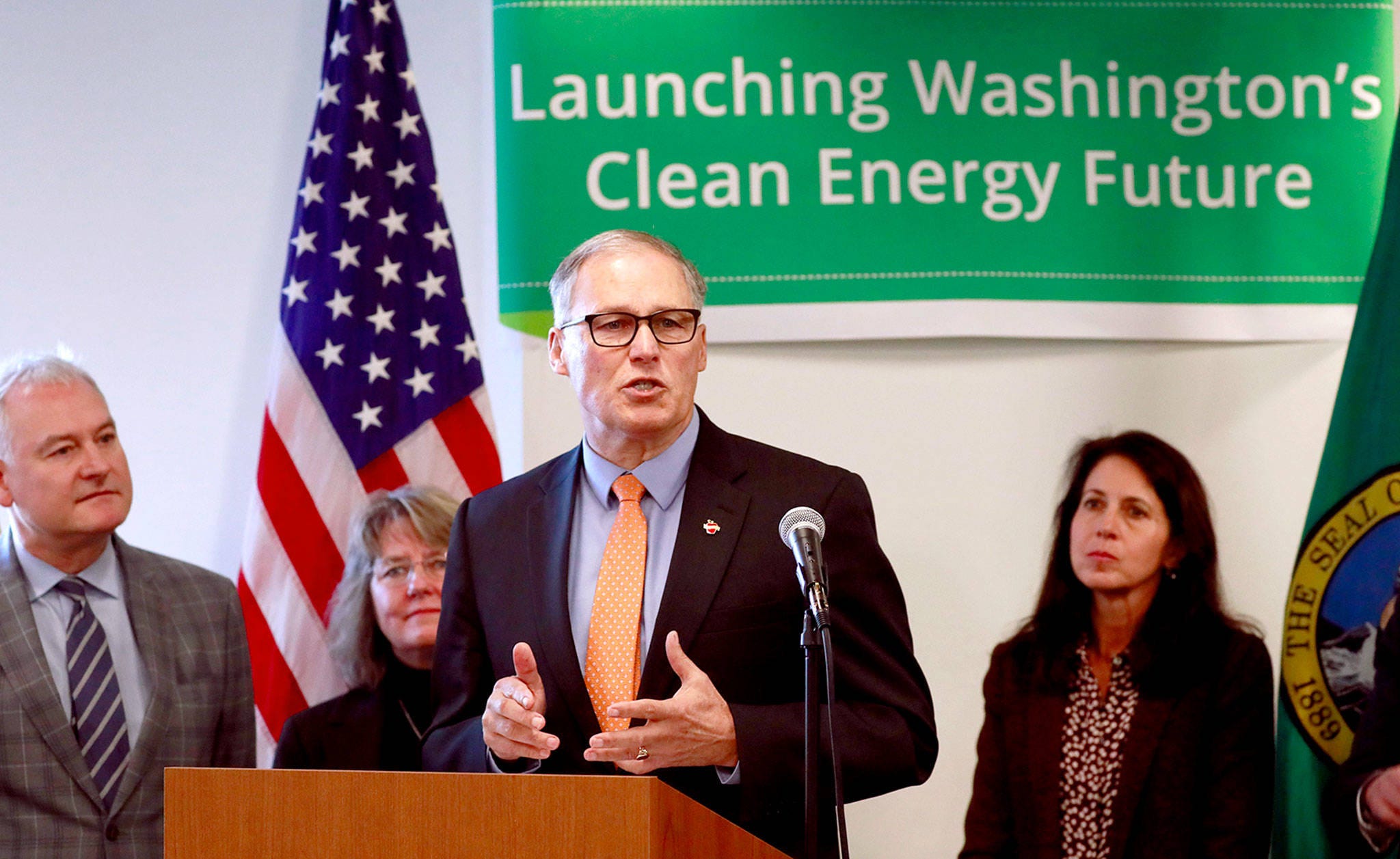
Jay Inslee Official Bio:
Over the past thirty years, Governor Inslee has provided bold leadership at the local, state and federal levels that has demonstrated the powers of innovation and inspiration to move our communities forward. More recently, his leadership as the three-term governor of Washington State has led to unprecedented success in building a clean energy economy, fighting climate change, improving opportunities for working families and advancing progressive values of Washingtonians.
Under Governor Inslee’s leadership, Washington has consistently ranked as one of the best states for both working families and business growth. Washington’s policies of constant innovation, openness to new ideas and a deep commitment to equity and inclusion are mutually supportive and demonstrably successful.
Governor Inslee’s leadership is deeply rooted in the values of Washington State. As a fifth-generation Washingtonian, who grew up in the Seattle area, he developed his environmental ethic hiking in the Cascade mountains and exploring tidepools with his parents. He worked his way through college operating bulldozers, married his high school sweetheart Trudi and graduated from Willamette Law School. He then established a successful law practice in the Central Washington town of Selah in 1976 where he and Trudi raised three sons and four acres of hay. After twelve years practicing trial law and prosecuting criminal cases, Governor Inslee’s desire to make a difference was whetted by his co-chairing a campaign to build a new high school, which led him to serve in the Washington State House of Representatives for the 14th district, after an upset victory, one of several in his political career.
Governor Inslee served in the U.S. House of Representatives representing Central Washington until his defeat in 1994, largely attributable to his vote to ban assault weapons. Following stints practicing law and serving as Director for the U.S. Department of Health and Human Services for the northwest, the Governor returned to Congress in 1999 representing the 1st District, becoming one of four people ever to represent two separate congressional districts. There he became notable as a leader of climate change issues and tech economic development matters and was a leading opponent of the Iraq war. During his term, he coauthored Apollo’s Fire: Igniting America’s Clean Energy Economy, a template for economic growth. Governor Inslee carried this vision into his unsuccessful but influential run for the presidency in 2019. His ideas became the basis of groundbreaking federal climate laws during the Biden administration.
Throughout his three terms, Governor Inslee established Washington as a leading state for climate action and a beacon of progress:
Created the Climate Commitment Act and successfully defeated an initiative to repeal it. Launched nation-leading policies related to 100% clean energy, clean buildings and clean transportation. The governor’s climate efforts also support innovation through the launch of the Washington Clean Energy Fund, a Clean Energy Institute at the University of Washington, and the Institute for Northwest Futures at Washington State University.
Promoted a more equal and just justice system. Governor Inslee placed a moratorium on Washington’s death penalty, which was ultimately affirmed by the state Supreme Court due to its unequal and racially biased application, and it was subsequently struck from state law. He also enacted several justice system reforms such as the Marijuana Justice Initiative and Community Reinvestment Fund and has been recognized for his leadership on clemency and reentry.
Led efforts to fully fund Washington’s K-12 education system and a historic expansion of early learning.
Led the transformation of Washington’s behavioral health system with a significant expansion of community-based facilities, a new teaching hospital at the University of Washington and a new forensic hospital on the grounds of Western State Hospital.
Defended access to reproductive health and gender-affirming care.


