

Afternoon everyone. Excited to share a new conversation with one of our party’s most inspiring rising stars - Governor Wes Moore of Maryland. You can find a video recording of our wonderful conversation above, and a transcript below.
In our conversation we talk about how the states are responding to the harms of Trumpism; of the progress Maryland has made in recent years; of his agenda that he calls “Work, Wages, And Wealth” (love that); the freeing last week of Maryland resident Kilmar Abrego Garcia and the fight to prevent Trump and Miller from trampling on our rights and liberties; and my favorite part, that comes at the end, when I ask the Governor whether there anything else that he is working on that he’d like to share with us. He gives a very Hopium answer, one that I promise will lift you up………
Here’s the Governor on the decision last week that finally set Kilmar Abrego Garcia free:
this is about due process. And when people said, well, you know, is there a judgment on Mr. Abrego Garcia’s background or his family relationship? I said, guys, we’re missing the point. The point is the president of the United States does not get to choose who gets due process and who doesn’t. That’s not the way this works, that you cannot say that you believe in this country and believe in the foundation of this country, but you’re picking and choosing which foundations you believe in. You know, this country has to be a country based on laws. And one of those laws that we will follow is that everybody here has the right to due process. And so the thing that we argued from the very beginning of this is it doesn’t matter what a person thinks of Mr. Abrego Garcia. What matters is that he had the opportunity to have due process, that a judge and a jury should be the ones determining what his future is going to be and not the president of the United States just sitting in the Oval Office.
And so… I am ecstatic that fundamentally what happened was due process won. What happened was the rule of law won. And they looked at the president and they did not blink. When they said, the president, Mr. President, you do not get to pick and choose which laws we are going to follow. We are going to follow the Constitution. That is the only ask that we have. And so I’m thankful that courts and the judges made the decision to be able to follow the rule of law, which is exactly what happened in this case.
I really enjoyed this conversation with Governor Moore, and am pleased to be able to help our community get to know him a little better.
So enjoy this wonderful interview, share it with others, and keep working hard everyone! - Simon
Governor Wes Moore Official Bio
Wes Moore is the 63rd Governor of the state of Maryland. He is Maryland’s first Black Governor in the state’s 246-year history, and is just the third African American elected Governor in the history of the United States.
Born in Takoma Park, Maryland, on October 15, 1978, to Joy and Westley Moore, Moore’s life took a tragic turn when his father died of a rare, but treatable virus when he was just three years old. After his father’s death, his family moved to the Bronx to live with Moore’s grandparents before returning to Maryland at age 14.
Moore is a proud graduate of Valley Forge Military Academy and College, where he received an Associate’s degree in 1998, and was commissioned as a second lieutenant in the U.S. Army. Afterward, he went on to earn his Bachelor’s in international relations and economics at Johns Hopkins University in Baltimore, where he graduated Phi Beta Kappa.
While at Johns Hopkins, Moore interned in the office of former Baltimore Mayor Kurt Schmoke. Moore was the first Black Rhodes Scholar in the history of Johns Hopkins University. As a Rhodes Scholar, he earned a Master’s in international relations from Wolfson College at Oxford.
In 2005, Moore deployed to Afghanistan as a lieutenant with the 82nd Airborne Division, leading soldiers in combat. Immediately upon returning home, Moore served as a White House Fellow, advising on issues of national security and international relations.
In 2010, Moore wrote “The Other Wes Moore,” a story about the fragile nature of opportunity in America, which became a perennial New York Times bestseller. He went on to write other best-selling books that reflect on issues of race, equity, and opportunity, including his latest book “Five Days,” which tells the story of Baltimore in the days that followed the death of Freddie Gray in 2015.
Moore built and launched a Baltimore-based business called BridgeEdU, which reinvented freshman year of college for underserved students to increase their likelihood of long-term success. BridgeEdu was acquired by the Brooklyn-based student financial success platform, Edquity, in 2018.
It was Moore’s commitment to taking on our toughest challenges that brought him to the Robin Hood Foundation, where he served for four years as CEO. During his tenure, the Robin Hood Foundation distributed over $600 million toward lifting families out of poverty, including here in Maryland.
While the Robin Hood Foundation is headquartered in New York City, Wes and his family never moved from their home in Baltimore.
Moore has also worked in finance with Deutsche Bank in London and with Citigroup in New York.
Moore and his wife, First Lady Dawn Flythe Moore, have two children – Mia and James – and a dog, Tucker Balti.
Rosenberg-Moore Transcript
Simon Rosenberg:
Welcome, everyone. Simon Rosenberg back with another great event. This is another in our series of interviews that we’re doing with people who are rising leaders who are going to be carrying us forward in this challenging time for the country and for our party. And joining me today is Governor Wes Moore of Maryland. Welcome, Governor.
Governor Wes Moore:
It’s great to be with you, Simon. Thanks for your leadership.
Simon Rosenberg:
Listen, so glad to have you here. Author, combat veteran, Rhodes Scholar, first Black governor of Maryland, remarkable resume. I also just want to say that I’m a huge admirer of your speaking skills and one of our most, I think, powerful orators and speakers and communicators in the Democratic Party. So it’s really great to have you here.
Governor Moore:
A lot of pressure right now man!
Simon Rosenberg:
[Laughs.] I think you can handle it. Hopium’s kind of a happy and fun community. No pressure here. No pressure, but thank you. Listen, I want to begin with something we’ve talked about a lot inside of our community. That the battle against Trumpism is going to really significantly move to the states in the early part of next year as state governments and local governments come back together and convene to now deal with the wreckage of what’s happened this year. We have a slower economy, higher inflation, attack on our social safety net, gutting of our healthcare system, utility prices are rising. Maryland has had its own specific challenges with the cuts to NIH and the cuts to the federal government. How are you thinking about leading the state forward given all this in the next couple of years?
Governor Moore:
Well, you’re absolutely right. The battle to combat Trumpism, it has to be led by the states because in many ways, the battle Donald Trump has started first meant attacking our states. You know, the state of Maryland, we have seen a greater assault against us than any other state in this country since Donald Trump has come on board. Donald Trump has now fired over 15,000 federal workers who are Marylanders. Donald Trump has now withdrawn billions of dollars that were set and slated to come to not just our state, but also to our institutions, to our institutions of higher learning, to our anchor institutions within the state. We have seen now that since Donald Trump has become the president of the United States, we’ve seen how energy prices have risen over 20%. And so the assault that he is doing on our states, it is significant and it is severe. The thing that we know though, is that this actually creates a really interesting opportunity because it’s never mattered more who your governor is. And it’s never mattered more who your local elected officials are, who your attorneys general are. Because one thing that we’ve been very clear is that in this moment, we’re not just gonna push back against Donald Trump, we’re gonna push forward.
You know, that we’re going to push back, for example, how we’ve been able to not just sue the president on multiple occasions, but beat him almost every time. When he decided to try to break the law to weaponize food. When he decided to try to take federal assets away from the state of Maryland, we decided to take him to court. And not only were we able to win the lawsuit for SNAP, but also we saw that when the president of the United States wanted to try to take SNAP benefits away from our people, that we actually tapped into our fiscal responsibility fund, which is actually made up of capital gains taxes, and said we’re going to take $60 million from that to make sure that no one in our state would have their SNAP benefits interrupted and people would not go hungry because the president of the United States decided to break the law.
When the president said that they were going to start firing federal workers, what did we do? We then decided to do things like our Feds to Eds initiative and get our federal workers inside the classroom to be teachers and inside of hospitals to be nurses. And what we have seen from that, just from those initiatives that we’ve seen alone, is that we’ve been able to cut, just during my time as governor, the amount of teacher vacancies in our state by half.
Much of those people were federal workers who then came on to become educators inside of our classrooms. That when the president of the United States decided that he wanted to start banning books, I signed legislation banning the banning of books in the state of Maryland. And so we’ve been able to not just push back on him, but push forward and to show that there is a better way. And that is something I think that governors uniquely are able to do right now.
Simon Rosenberg:
Yeah, I think it’s such a great story that you just told because I think that so oftentimes people are following the national news, but these battles are taking place throughout every community in the country in terms of… their agenda, how it’s affecting working people all around the country. And as you look to next year, I mean, you’ll be giving a State of the State at some point in the next month or so and laying out your agenda. What are some of the things that you’re thinking about now that you may try to get done next year?
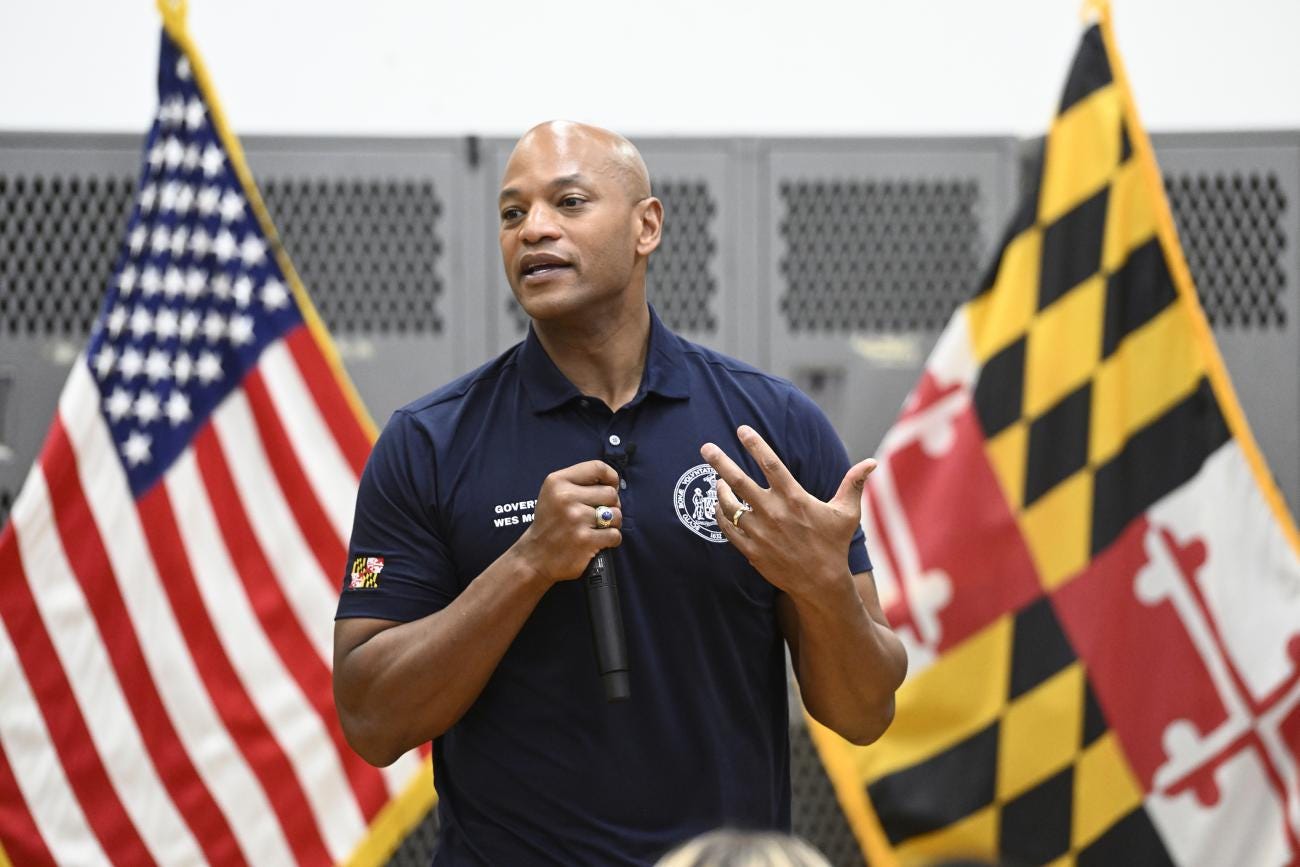
Governor Moore:
Well, you know, a lot of our focus is going to be on economic growth and also just making sure we can make life more affordable for the people of our state.
You know, we really came in, and when I ran for governor — and remember, I had never run for office before in my life — you know, that I’m probably the most improbable governor inside this country when you consider, not just my life journey and life story, but the fact that I didn’t come in with the political experience that many people said that you needed to be able to become the chief executive of your state.
And I said, the north star for us is going to be threefold. It’s work, wages and wealth — creating pathways to work, wages, and wealth for all Marylanders. And you’re going to see that with the work that we’re doing now. It’s the reason that we’ve been able to do things like making sure we can quadruple the amount of apprenticeship and trade slots inside of our state and saying we have some of the best four-year colleges, but not every one of our students needs to attend one of them in order to be economically successful. It’s the reason why I signed the largest mass pardon in the history of the United States of America, where I pardoned over 175,000 misdemeanor cannabis convictions in the stroke of a pen to get people back into the workforce. It’s the reason we raised the minimum wage inside of the state of Maryland and said people should not be able to work jobs, in some cases multiple jobs, and still live at or below a poverty line. It’s the reason we gave the middle class a tax cut and asked wealthy Marylanders to pay a little bit more. Because I do not think it’s inappropriate to say we’re going to give the middle class a bit of relief while asking very wealthy Marylanders to invest a little bit more, so you can make sure that we have the best public schools in the country, to make sure we’re not laying off police officers and firefighters.
And it’s the reason we’ve been so aggressive - and you’re going to see it again in this next session - about how we’re thinking about housing and ensuring that we can build more housing to give people a chance to be homeowners because homeownership is the greatest pathway to long-term wealth that we have within our society and stability. And so work, wages, wealth — those are the things that you’re going to see while also being very clear that in this moment, we are going to protect our people from the other value ravages that we’re seeing from this federal administration.
Simon Rosenberg:
Well, and speaking of that, first of all, I love work, wages, wealth. I think it’s awesome. It’s a great articulation of this idea that, you know, because we often talk about at Hopium, if Democrats aren’t for opportunity, then what are we really for at the end of the day, right? And it’s a great articulation of that. We look forward to seeing how you fight this out in the legislature next year and what your full agenda is going to be. We’ll have you back or have somebody back from your team to come give us an update. But speaking of the other assault, you had one of the most high profile cases in the country of this effort to strip rights and freedoms away of Americans with Kilmar Abrego Garcia, who incredibly was just released last week from detention, prison, whatever it is that he’s been put through. What are your thoughts as having had a resident of your state be really sort of almost the poster child for Stephen Miller’s extremism and assault on our freedoms and liberties?
Governor Moore:
You know, we were very vocal about this from Jump Street. And the reason was simply because this is about due process. And when people said, well, you know, is there a judgment on Mr. Abrego Garcia’s background or his family relationship? I said, guys, we’re missing the point. The point is the president of the United States does not get to choose who gets due process and who doesn’t. That’s not the way this works, that you cannot say that you believe in this country and believe in the foundation of this country, but you’re picking and choosing which foundations you believe in. You know, this country has to be a country based on laws. And one of those laws that we will follow is that everybody here has the right to due process. And so the thing that we argued from the very beginning of this is it doesn’t matter what a person thinks of Mr. Abrego Garcia. What matters is that he had the opportunity to have due process, that a judge and a jury should be the ones determining what his future is going to be and not the president of the United States just sitting in the Oval Office.
And so… I am ecstatic that fundamentally what happened was due process won. What happened was the rule of law won. And they looked at the president and they did not blink. When they said, the president, Mr. President, you do not get to pick and choose which laws we are going to follow. We are going to follow the Constitution. That is the only ask that we have. And so I’m thankful that courts and the judges made the decision to be able to follow the rule of law, which is exactly what happened in this case.
Simon Rosenberg:
Yeah, it is very affirming. It’s been grueling to watch. I mean, the cruelty, and sort of maniacal cruelty that we’ve seen from the administration on this one person, right? They have clearly become obsessed with this one person… it has been shocking. And it feels very un-American in so many ways. And so thank you for your continued strong advocacy for this… we have a lot of battles ahead on this front.
Governor Moore:
And that’s the thing. And you’re right, Simon… there is no character assassination… no character assassination ever justifies us just blatantly breaking laws or blatantly breaking rules. That they could put together whatever they wanted about this individual. The only thing we’re asking is follow the Constitution and follow the law.
Simon Rosenberg:
It shouldn’t be a big ask.
Governor Moore:
It should not be a big ask.
Simon Rosenberg:
Let me ask you one last thing before we go…what else are you looking forward to? I mean, how are you when you get up every day? Is there anything we didn’t talk about today that you’re excited about that you’ve been working on, the opportunities that you have next year that you’re looking forward to?
Governor Moore:
You know, one thing I’m really looking forward to is next year we’re going to get a chance to celebrate the 250th anniversary of this country, but also the state of Maryland. And here’s the reason why I’m really looking forward to that is I want for our state to know our history. Because I believe deeply that if our state knows our history, our state will understand that our future is much brighter than people might feel, particularly despite this assault that we are seeing from our federal government. That we have to remember the history of this state is complicated. I say where the flag that we have here in many ways, it’s in my state flag, it’s a contradiction. Because it’s literally a flag that is a combination of a Union symbol and a Confederate symbol. That Maryland is the northernmost southern state in this country, that the Mason-Dixon line runs through our state, that we are the home of redlining and some of the most creatively racist policies in the history of the United States of America. And despite all of that, that we are here. That we still have an ability to control our own destiny, and that I am convinced that Donald Trump does not get a chance to determine what our democracy looks like. The people of Maryland will determine what our democracy looks like. And so the thing that really gets me… that I’m excited about is, you know, we are going to be able to buck these national trends as we continue to see where Maryland’s gone from 43rd in the country in unemployment, now having amongst the lowest unemployment rates in the entire country since our administration’s come on board. We’ve had amongst the fastest drops in violent crime anywhere in the United States of America. That we’ve been able to have new initiatives like making Maryland the first state in the country that has a service year option. The first most aggressive assault on child poverty in our state’s history. The work we’re doing around men and boys. Like we’re doing some really good and important work that I’m excited about. But I’m really excited that the people of our state will understand our power because the people of our state are going to understand our past.
Simon Rosenberg:
You know, I love that because, you know, I grew up in the New York, Connecticut area, and I moved to D.C. My house where I live and where I’m talking to you from is about a half a mile from the Maryland border in northwest D.C., and I’ve spent a lot of time in Montgomery County in my life. And in my time in Maryland, I have been struck by what you just said. It’s a state with incredibly complex history. And part of the story is it’s overcoming… and building this very modern, remarkable place. I mean, Maryland is one of the greatest places to live in America. There’s no doubt about that. I think my wife and I will regret a little bit sometimes having picked D.C. [laughter] as opposed to Montgomery County, but we’ve raised our three kids here and it’s gone really well. Maryland is, I will just say this as somebody who’s lived here, Maryland is a remarkable place. And you are blessed to be governor of such a remarkable place. But I love that you’re going to try to remind people of its complicated history because it is an important part of its journey as a state.
Governor Moore:
It is. And it’s an important thing to remember in this. And I always say, and part of the reason why I was proud to sign legislation banning the banning of books is to say that loving your country doesn’t mean lying about it. You know, loving your country means embracing all of its complications, flaws and all, and still be willing to fight for its future. That’s patriotism. And that’s loving your country.
Simon Rosenberg:
Amen to that. What a great way to end. Thank you, Governor. I know you’ve got a lot of work to do today. Thanks for dropping by. Perhaps we’ll have you come back sometime early next year to give us an update on your legislative agenda. And thank you for your just incredibly passionate and capable leadership. You’ve been an inspiring voice for us in a time of challenge and thank you for dropping by today.
Governor Wes Moore:
God bless you, Simon. It’s great to be with you. Thanks for everything.
Simon Rosenberg:
Thank you. Thanks everybody. I hope you enjoyed it… the governor is one of our most important rising leaders in the Democratic Party in a time of enormous challenge. This was a wonderful interview… thanks, everybody.


