

Greetings all. The great patriot Marc Elias dropped by earlier today for a conversation. A video recording can be found above and a transcript is below. Here’s how Marc kicked off our discussion:
So, look, the good news is that right now democracy is holding. You know, the Supreme Court did enormous damage to the institutions of our government, and we can’t overlook those, right? The Callais decision gutting the Voting Rights Act, the Slaughter decision giving Donald Trump nearly unfettered power to fire people in his administration, with some exceptions limited to perhaps just the Federal Reserve Board… though he really can’t… so we saw a lot of damage. And even in the cases that we won, a big case I won involving mail-in ballots, it was 5-4… shouldn’t have been that close. The birthright citizenship case, which is sort of 6-3, but is really 5-4 in the constitutional claims… certainly should not have been that close. Campaign finance case that I lost, 6-3. You know, we are seeing the fraying of this at the court.
Meanwhile, in the political arena, Donald Trump has hijacked the 250th anniversary to his own benefit. It was just reported that he has made untold amounts of money through various schemes and grift that I suspect we don’t even have the full picture of. The election systems are under attack. You know, the new Director of National Intelligence is a Trump partisan, not someone with experience, with national intelligence. We see states buckling under the strain of election deniers trying to infiltrate their offices and also attack them.
So look, we’re going to have elections this fall. They are going to be conducted and no one can cancel them. And all of that… how fair and free they are is going to be a function of the hard work that is done between now and then. Not just in the courtroom, but also in the organizing, the voter education, in the turnout, in the communications. There’s going to have to be a lot of effort to make sure that people understand how they vote, how they’re registered, that they vote, that those votes are counted and tabulated accurately.
While there is a lot in our conversation for you to chew on I want to drill down now on something Marc and I discuss at length, as we did in the first time he dropped by a few months ago - the need for Democrats to make Trump’s escalating illiberalism and ongoing attacks on our democracy central to our conversation with voters this fall.
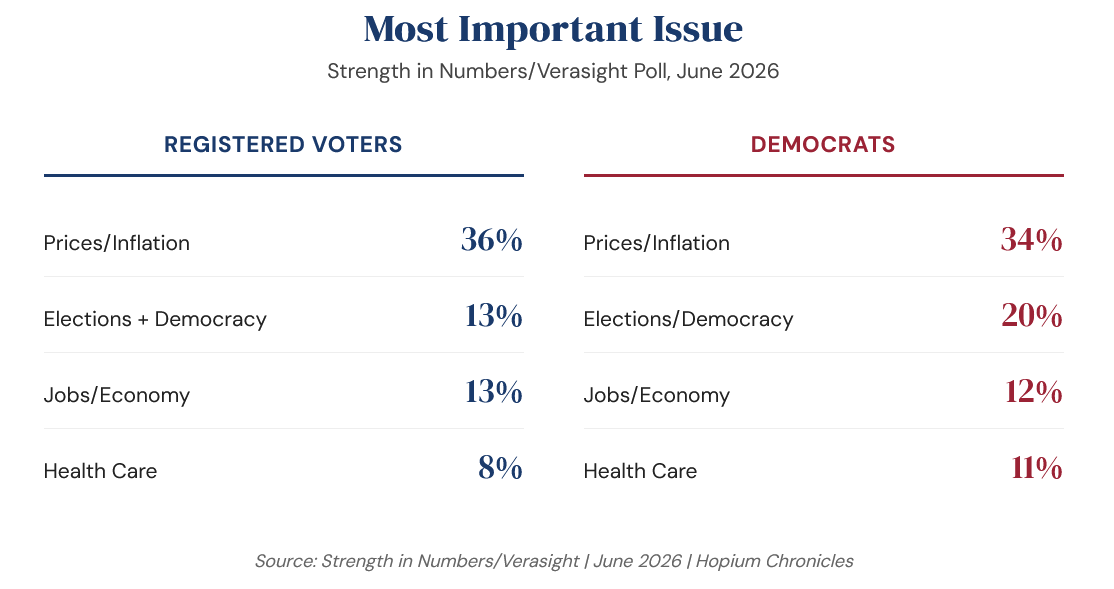
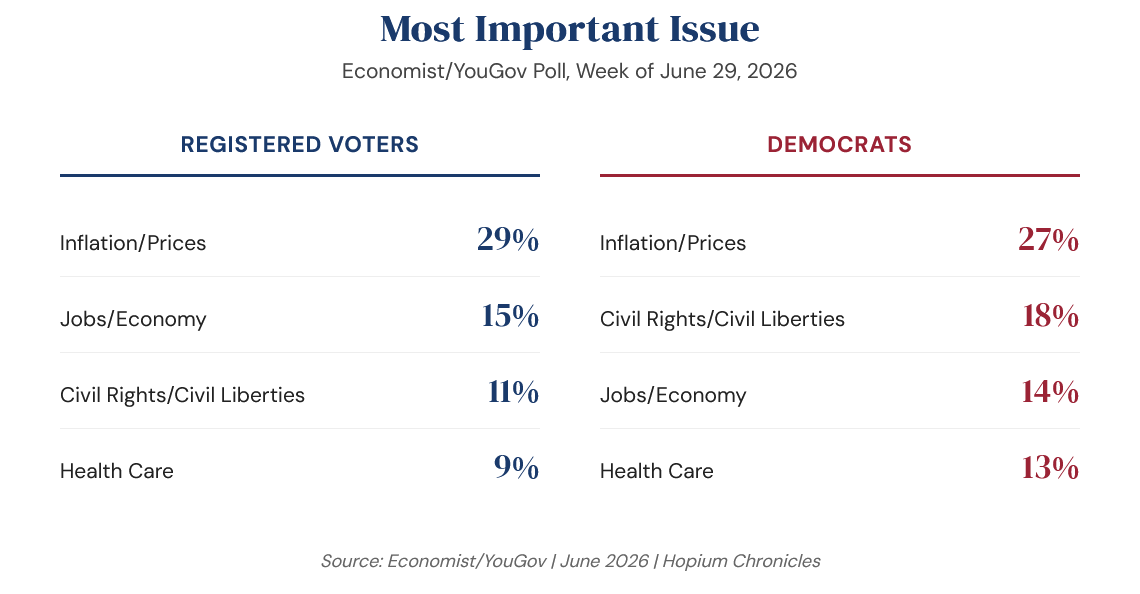
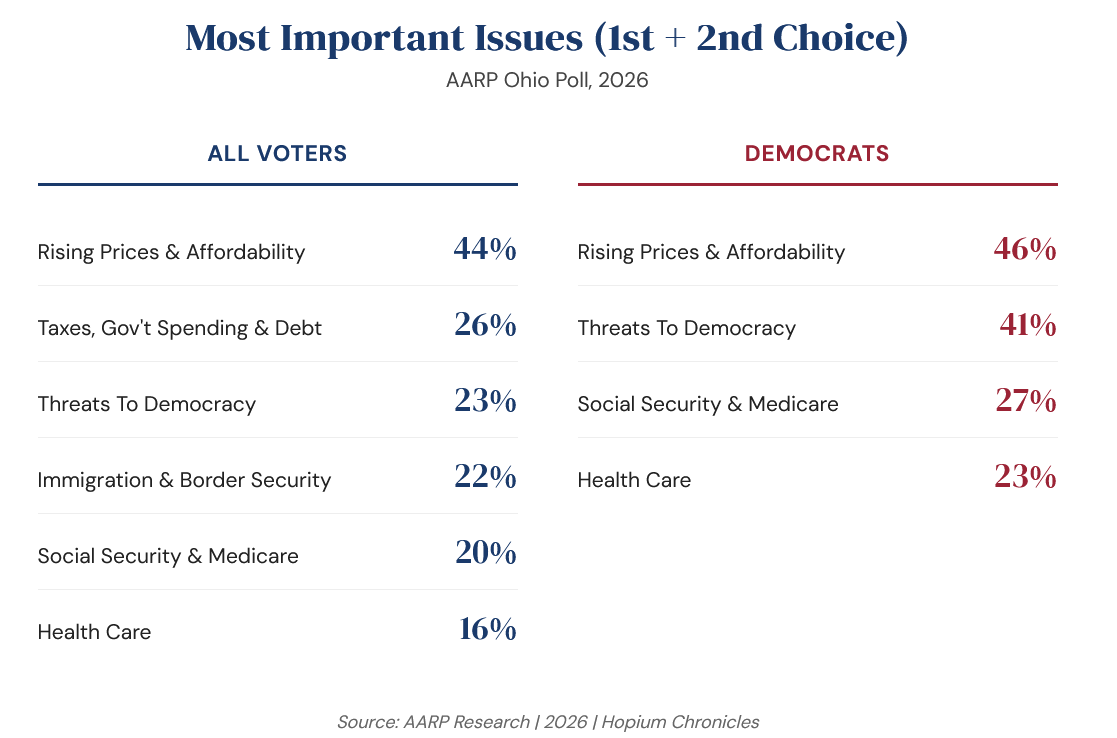
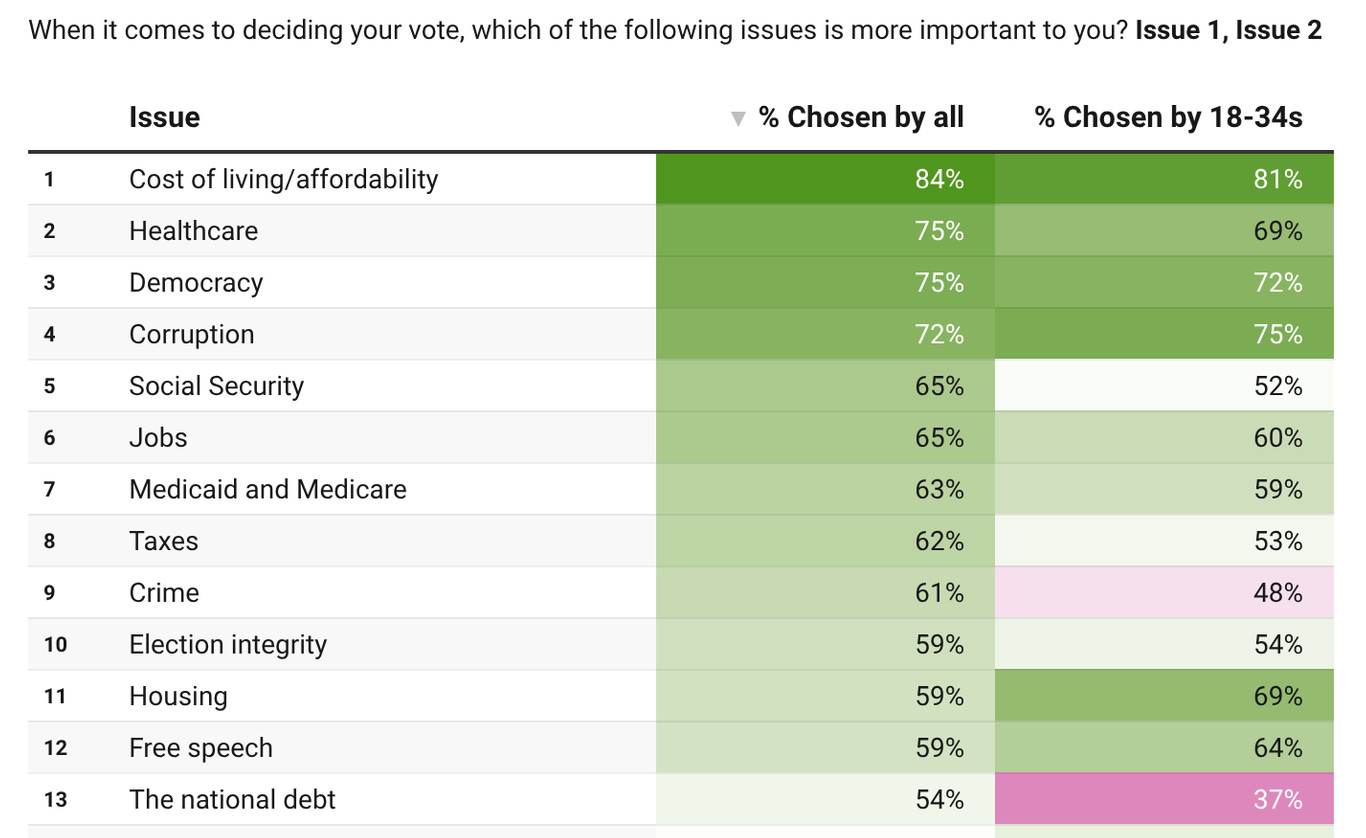
As we discuss we need to do this for two primary reasons: 1) we need to be able to claim an electoral mandate for an ambitious reform/pro-democracy/accountability agenda when back in power 2) the issue of democracy, and our rights and freedoms, is important to voters, particularly to those in our electoral coalition. Yes, my friends, No Kings is not just the right thing to do it is good politics too.
Let’s look at the “most important issue” question over four recent polls:
From the Spring Yale Youth Poll:
In this post from December, 2025, In 2026 Democrats Can Be Both Warriors For Working People Against Oligarchy AND Proud Patriots Fighting For Democracy Here And Abroad, I did a recap of polling from the fall that showed how central “threats to democracy” was to our enormous election victories a month earlier. The post has lots of data in it but the most important came from the last CNN poll done right before the election:
registered voters who are Democrats or Democratic-leaning independents are far more likely than Republican-aligned voters to say they are extremely motivated to vote next year (67% compared with 46%). Those Democratic-aligned voters who consider the state of democracy to be a top concern are perhaps the most fired up within the party: 82% in that group say they are deeply motivated to vote, compared with 57 % among Democratic-aligned voters who call the economy their top concern.
Yes, we can be both warriors for working people and proud patriots fighting for freedom and democracy here, and everywhere. It is not an either/or, or a pivot, but an and/both. We can and must do both.
I am grateful that Marc was able to drop by today, and am even more grateful for his essential leadership in this challenging time. Do subscribe to Democracy Docket and learn from the remarkable community of writers and commentators he has assembled there. Please hit like so more people will see our conversation, share it with others, and keep working hard all. We have a country to save, and elections to win, together! - Simon

Transcript - Simon Rosenberg And Marc Elias (7/1/26)
Simon Rosenberg:
Hey, welcome everyone. Back with another terrific event today. Joining me is one of the great pro-democracy warriors of our time, Marc Elias. Marc, thanks for coming back.
Marc Elias:
Thanks for having me.
Simon Rosenberg:
So we’re at this moment where the election is four months away. Early voting is 11 weeks away. We just ended the Supreme Court term, and you know, we're celebrating our 250th birthday. Just take a step back and give us your assessment of where we are in this battle for our freedom and our democracy given your perch where you're in this thing every day on the front lines.
Marc Elias:
So, look, the good news is that right now democracy is holding. You know, the Supreme Court did enormous damage to the institutions of our government, and we can't overlook those, right? The Callais decision gutting the Voting Rights Act, the Slaughter decision giving Donald Trump nearly unfettered power to fire people in his administration, with some exceptions limited to perhaps just the Federal Reserve Board… though he really can’t… so we saw a lot of damage. And even in the cases that we won, a big case I won involving mail-in ballots, it was 5-4… shouldn't have been that close. The birthright citizenship case, which is sort of 6-3, but is really 5-4 in the constitutional claims… certainly should not have been that close. Campaign finance case that I lost, 6-3. You know, we are seeing the fraying of this at the court.
Meanwhile, in the political arena, Donald Trump has hijacked the 250th anniversary to his own benefit. It was just reported that he has made untold amounts of money through various schemes and grift that I suspect we don't even have the full picture of. The election systems are under attack. You know, the new Director of National Intelligence is a Trump partisan, not someone with experience, with national intelligence. We see states buckling under the strain of election deniers trying to infiltrate their offices and also attack them.
So look, we're going to have elections this fall. They are going to be conducted and no one can cancel them. And all of that… how fair and free they are is going to be a function of the hard work that is done between now and then. Not just in the courtroom, but also in the organizing, the voter education, in the turnout, in the communications. There's going to have to be a lot of effort to make sure that people understand how they vote, how they're registered, that they vote, that those votes are counted and tabulated accurately.
So, I wish I could say that on the 250th anniversary democracy is stronger than it's ever been, but it's not. It's not as strong as it was even was, Simon, two years ago.
Simon Rosenberg:
Well, yeah, so much there to go through. And I do think one of the things we're been focusing on at Hopium, as part of the things that we need to do between now and November, is we're going to try to lead an effort to encourage people to vote early.
Just as you and I discussed this, you know, in our private calls as a piece of the overall thing that needs to get done. We're going to continue to raise money for candidates and be election-focused. But I think there really does need to be a national commitment by the family to to be talking about, to your point about just the act of voting itself, and making this patriotic act… right, something that is central to our conversation. That it can't just be about kitchen table issues. There's got to be this other piece that's part of the discourse.
Marc Elias:
I think you are touching on a really important discussion that is not always taking place. You know, I understand that the kitchen table issues are critical and important. I know that people are hurting with inflation and the Iran war has only made that worse. I know that the tariffs are devastating farmers and raising prices for everybody. I understand it, but, you know, not to share too much of our off air conversations, but you oftentimes boost me by sending me polls that show that people also do care about these democracy issues. And in some sense, Simon, whether they poll test the best or not, they have to be part of the conversation because for people to understand the context of these other things it needs to be understood that Donald Trump has turned the Republican Party into a massive voter suppression war machine.
And his administration is weaponizing government against his political opponents, not just for the sport of it, not just for the revenge of it, but also as a way to hold and gain more power. And I think that that, I don't want to say tension, but that balance, I think, is really important.
Simon Rosenberg:
You know, the last time you were on a few months ago, right before you came on, we had interviewed a guy named Hardy Merriman, who has worked all around the world to prevent backsliding in democracies and to restore democracy when it has stumbled in countries. And one of the things he talked about was that [in] the most successful projects to reverse backsliding… the party or the candidate that runs… runs explicitly in the election on whatever reform movement is required in order to have the imprimatur from the public to be able to say we have a mandate to make these kinds of reforms.
And so, in my view this discussion now that we're having… that it's not only that we need to talk about democracy and Trump's assault on our rights and liberties because our electorate wants us to based on polling and therefore we will be more likely to win, but it's also because we have to create the perception of a mandate. I was in a meeting a couple days ago with a prominent Democrat who talked about how Peter Maygar won in Hungary by staying focused on kitchen table issues. And that's just not what happened in that election… I mean, it was a complete misread of how Peter Maygar ran. He openly talked about Russia and Europe and big choices they had to make, the reforms, restoring democracy that had been taken away. It was central to his whole narrative.
And so I do think that part of our work, Marc, together is we've really got to create permission structure in our families for us to lean into these democracy issues, you know, the voting issues… it's essential that in the next few months we work to get us to a better place on these things, I think. Or a more ambitious place is perhaps a better way of describing it.
Marc Elias:
I think that's right. First of all, I wholeheartedly endorse the idea that people need to vote early. And early in-person voting honestly is right now, if not the safest, certainly as safe as any other form of voting. You avoid the potential of anything from problems on Election Day that just come up, to weather events that happen that are unavoidable… we saw bombs called in. Bomb scares called in, false ones, to try to disrupt the elections in 2024. So you avoid all those things, and honestly you don't have ballot rejections the same way you do with mail-in voting now. That's not to say anyone who wants to vote by mail shouldn't do so, but early in-person voting where it's available… in some ways if someone asked me, you know, if they're concerned their vote’s not going to count, I'd say early in person may be your best bet.
But I want to pick up, Simon, on your your larger point. And there's a lot of literature that came out probably three, four years ago about, like, what is the Democratic Party? What is the Republican Party? What are political parties and there was sort of this range of it. The formal party institutions, the institutions plus interest groups, candidates… you know, movement organizations aligned with them. And there was a lot of debate over where you draw those lines.
I do wonder Simon as someone like me who is both connected institutionally to the success of the formal Democratic Party and its candidates, and also in this space of trying to educate people through direct communications, you know you have built an enormous and successful community with Hopium… like the extent to which these efforts are actually, I guess, party-adjacent, but also in some ways doing work that is as critical to elections being safe and secure as is anything else.
Simon Rosenberg:
I mean, the way that I talk about it at Hopium is that there's an evolving battlefield that the political battlefield and terrain that we're playing on is evolving and growing. And basically, we're now not only just trying to win traditional elections but we're also trying to preserve democracy in the process. Many Americans I think don't have experience in these matters, right, we have been a democracy for a very long time, and I think that sort of American exceptionalism has become an inhibitor to us having the kind of robust conversations that have been easy in places like South Korea and Hungary, and other places that have already gone through backsliding, right. Or where they have histories in their own countries of authoritarian rule that are recent… so I think we have a lot of work to do about creating the public conversation around all this. That it’s still seen as something to pivot from rather than to lean into, and I think that, you know, Marc one of the things we should explore offline is about creating more of an organized effort to do this.
So it's not all of us working in our disparate capacities. To make it louder, to make us louder and more effective. It's something we should, you know, get together on and talk about. I think it's necessary. We're going to do our piece but it will be better if we were all working together I think, as we had towards the election, and I know you're involved in many organizations and coalitions and so on through your work. Before we go, because we're going to run out of time in a minute, will you just talk a little bit about, for those that don't know you that well that may know Marc Elias the super lawyer, democracy warrior… talk about Democracy Docket and how people can subscribe and get involved in it. Also about your wins recently. You've had an incredible string of victories that I think are important for us to celebrate here today. So just give us a little bit of background on both those things, if you would.
Marc Elias:
Yeah, so to your point about building community and banding together, and making sure that we can amplify and grow larger, you know, I looked out on the landscape in the spring of 2020. The pandemic had begun, but we didn't really know that we were yet in the middle of a pandemic. But it was clear that Donald Trump's reelection campaign was going to be premised on making it harder for people to vote and easier for him to cheat. And I looked out on the landscape and there just were not a lot of places people could go to get focused coverage and information analysis about that effort in particular.
And there was a lot going on in the courts and more to come, and so I built Democracy Docket to be kind of an online platform for people to gain that information and education. And also to find, hopefully, community with people who were really focused on what is happening to democracy and for fair elections particularly in court. And it has grown it is now more than 475,000 free subscribers. It's got a paid premium membership program, and that is my part in giving back to that community, as a lawyer. I run a law firm that has 60 plus lawyers and we are litigating more than 80 cases in 43 states. We had a big win in the Supreme Court in the Watson case that protected mail-in voting.
And we've had a number of important victories in preventing the Department of Justice from getting access to sensitive voter data information. The Trump administration has sued in 31 states plus the District of Columbia to gain access to that information. We intervene to defend voters from having their information turned over… so far, the Trump administration is still searching for its first victory. It is 0 for 11 in the trial courts and is 0 for 1 in the Court of Appeals. So we are undefeated in this effort. I predict that our record is going to improve in the next few days… that works continues and that work’s important. We will fight like hell between now and the election, and if necessary, afterwards to ensure that every lawful voter can vote and have their ballot counted. And that the elections are accurately certified. So those are kind of like the two parts of my life, right? One part is fighting in court as a lawyer every day and then usually on nights and weekends writing for Democracy Docket. And Democracy Docket's got more than 30 people who keep it going in the meantime, you know, in between what I do and just trying to educate everyone.
Simon Rosenberg:
Well, I'm now linking to Democracy Docket three, four times a week easily, to the stories because they're the best encapsulations of what's happening here in a way that I can share with my audience. Oftentimes, I think the articles are more informative and better written than what we get in the Times and the Post so hats off to you.
Marc Elias:
We've had the benefit of, you know, legacy media's decline. It has been Democracy Docket's benefit, which is, you know, we have former reporters from from Axios, former reporters from CBS News, you know, we're growing and they provide in-depth coverage of these issues. It's the only thing we cover and they do it with a pro-democracy lens.
Simon Rosenberg:
Let me ask one last question today. The ruling yesterday about party committees and campaigns. Can you explain what that means for this election?
Marc Elias:
I will, but it can't be the last thing because I need to hear your reaction to it because I was going to hijack your interview and ask you about it. So I'm going to set the table.
So, essentially, in the original campaign finance laws passed in the 1970s, there was a provision that limited the amount of money that political party committees, the big national party committees and the state parties, could spend in full coordination with their candidates. Now, this is not a small number. This is ranges from, you know, in the low hundreds of thousands to the multi millions, for example, in the Senate races. It's set per state, so they were able to spend this money essentially to pay the bills of campaigns or to coordinate expenditures. They had more authority than anybody else to to benefit their campaigns. Now, in addition to that the national party committees could also make unlimited independent expenditures where they spent that money independently of their campaign. The Republican National Committee in the late 80s started to plot a way to challenge the limits because they wanted to be able to make unlimited coordinated party expenditures, and they initially failed. They failed in a case in the mid 1990s, they failed in a case in 2001, but they kept at it.
And the Supreme Court, in a 6-3 decision yesterday, ruled that limit on how much parties can spend in full coordination with their candidates violates the First Amendment. I argued against that on behalf of the Democratic Party. We argued that those limits were constitutional and that stare decisis, the fact that these had been upheld before, should continue to keep the system sort of stable. The only thing that has changed since the 2001 ruling is the composition of the Supreme Court, and that doesn't instill confidence in the courts or in democracy.
Well, nevertheless, the Supreme Court, the six conservatives struck down those limits and you know, there's been a lot of commentary that this will greatly benefit Republicans in the 2026 midterm elections because they have more party money than than the Democratic Party does as a whole. I look at it a little differently and say that to me the question is in the long sweep… does this aid or not aid a stable party system? And I actually think it undermines that system in part because I think this is the prelude to the Supreme Court striking down other contribution limits, contribution limits to candidates, to parties, contribution limits from PACs to parties. I just think this is the next step to the dismantling of the campaign finance system in its entirety.
Simon Rosenberg:
Yeah, and I think that, you know, there's been a lot of commentary that this was a way of them mitigating or countering our advantage in low dollar donors, and I wanted to say for everybody watching what happened yesterday was in response to the incredible power that we've created through the democratic grassroots and our ability to raise hard money for candidates around the country. We've raised far more than they've been able to raise. They've been much more reliant on a couple hundred major big donors, but we've been relying on seven million people to fund our campaigns… one of the reasons I'm excited to talk to you today, because we didn't know that this would come down… it was likely, but I think number one is that in a campaign it's still better for the candidate and the people around the candidate to have the most money. They're much more likely to make smart and quick decisions to adjust than a lumbering party committee, you know, or a superPAC. It is harder for them to stay close to the ground. So our hard dollar advantage is still deeply meaningful for us…
And particularly because it's so late. I mean, they haven't been working together for the last 18 months. This is going to be different for ‘28. But it also does something. The second part of that is that I think it also strengthens the parties in the short term. I’m okay with this, and not everybody is. I'm a strong party guy in the family.
Marc Elias: Yeah, me too.
Simon Rosenberg:
And so I think that you know, this does strengthen the state parties and the party apparatus in a time when, you know, we've been moving in that direction anyways and under Ken Martin's tenure and Jane Kleeb’s tenure. So I think in the short term I'm not convinced it's going to sort of fundamentally change the balance of where we were going. However, I just want to say to everybody here, the low dollar donors that we have, the money that we've been raising, this is still the most important money. You get the greatest return on low-dollar, hard dollar fundraising and spending… [more] than in any of the other ways that you spend in the business. And that's why we have to maintain this advantage that we have and not let them psych us out.
That somehow this is going to fundamentally give them more power – we don't really know that yet. And it depends, to your point Marc that you've said every time we've met and discussed it, on how the best way that we have of countering, you know, their illicit activities is by winning this election by as much as we possibly can. And that still has to be job one for all of us.
Marc Elias:
I totally agree. I do think in the short term it's going to have the effect you said. I also think in the short term it will probably mean that the Democratic Party will be more united in the sense that state parties and national parties, rather than competing with each other, will now be able to work more integrated together as well as with the candidates. It's sort of a technical issue about how that limit used to be allocated between the state parties and the national party. Now that they all can do essentially the same thing, there will be a greater need and reason for them to cooperate.
Simon Rosenberg:
I know you've got a big meeting ahead of you, Marc. Thank you. And listen, as a fellow patriot on this week of our 250th birthday, just a huge thank you for your incredible leadership, your effectiveness, your wins, and staying in the fight. You're in this fight every day, and I'm just so grateful for all the work that you do. We're all grateful here in this community for your leadership.
Marc Elias:
Thanks, Simon. To be continued.
Bio - Marc Elias, Attorney And Independent Journalist
Marc Elias is the Firm Chair of Elias Law Group, a mission-driven firm committed to helping Democrats win, citizens vote, and progressives make change. Marc is a nationally recognized authority and expert in campaign finance, voting rights, redistricting law, and litigation.
As a litigator, Marc has handled hundreds of cases involving politics, voting rights, and redistricting. He has successfully argued and won four cases in the U.S. Supreme Court, as well as dozens of cases in state supreme courts and U.S. courts of appeal.
He has represented the Democratic Senatorial and Congressional Campaign Committees, several presidential campaigns, as well as dozens of U.S. senators, governors, representatives, campaigns, and other Democratic and progressive organizations.
When Trump contested the outcome of the 2020 election, Marc met every futile challenge at the courthouse, notching over 60 legal victories against the former president and his allies during the post-election period, alone. He has also successfully represented several House and Senate candidates in post-election litigation, recounts and challenges. In 2024, Marc was named to Forbes’ inaugural list of America’s top 200 lawyers.
Marc is also the founder of Democracy Docket, the leading digital news platform dedicated to information, analysis and opinion about voting rights and elections in the courts.
Marc is an alumnus of Hamilton College, Duke Law School and Duke Graduate School. He is a proud owner of a Portuguese Water Dog named Bode.


