


Greeting everyone. Sending along the video recording and transcript of my conversation this afternoon with legal commentator and former prosecutor Glenn Kirschner. As Gleen has been one my most important teachers in this dark age of Trump it’s always a thrill for me to able to spend time learning from him. Get to this informative and timely discussion when you can - it’s a good one!
I asked Glenn to come back and talk to us about the escalation we’ve seen with Trump in recent weeks - the new repeated assertions by Trump, Miller, and the regime that domestic and international law no longer applies to them; and ICE’s brutal and lawless campaign in Minnesota.
I thought the most interesting part of our discussion today was when Glenn walks us through all the ways ICE is breaking the law and violating the Constitution in Minnesota. This section comes right after we watched video a press conference in Minnesota of police chiefs loudly complaining about ICE’s terror campaign in the Twin Cities:
Yeah, let’s drill down a little bit on what we just heard Chief of Police Bruley say and the two ways ICE agents violated the law. And the victim happened to be a Minnesota police officer. And I’ve wondered aloud, often, over probably the entire first year of Donald Trump’s term, when the states would begin to assert themselves and protect their own residents, the people within their state borders, from crimes being committed by masked federal officers.
But let’s go to the basics. So the Fourth Amendment happens to be my favorite amendment. The right of the people to be secure in their persons, houses, papers and effects against unreasonable searches and seizures shall not be violated, shall not. Seizure is a fancy word, Simon, for the police stopping you in your car, the police trying to open your car door or telling you to get out of the car. That’s a seizure. There are other kinds of seizures like when you shoot someone, that’s a seizure. When you put your knee on their back or their neck, that’s a seizure. And there has to be the requisite evidence that can be proved ultimately in a court to satisfy the Fourth Amendment’s prohibition against an unreasonable search and seizure.
What Chief Bruley just described there, Simon, is both a crime in violation of Minnesota state law and the violation of the Fourth Amendment. So first of all, when you grab the cell phone out of somebody’s hand, that’s an assault. It could also potentially be a robbery. It’s an assault… it doesn’t have to result in injury. That violates Minnesota state law and virtually the law of all 50 states. When you see somebody without reasonable, articulable suspicion that they’ve committed a crime, there has to be evidence of that. you have violated their Fourth Amendment right against an unreasonable seizure. So those ICE agents violated both the state law and the Constitution. What are the local police going to do about it? If it were me… I was a career prosecutor 30 years, both in the army as a JAG and at the DOJ for 24 years, specifically the DC US Attorney’s Office. You know, you need to hold federal officers accountable for committing crimes in your state if you’re a state law enforcement authority.
I think the Fourth Amendment has become my favorite Constitutional Amendment too. Here is it for those who need a reminder. It is simple and incredibly powerful, and something we must all become more familiar with now:
The right of the people to be secure in their persons, houses, papers, and effects, against unreasonable searches and seizures, shall not be violated, and no Warrants shall issue, but upon probable cause, supported by Oath or affirmation, and particularly describing the place to be searched, and the persons or things to be seized.
I agree with Glenn’s main point that he makes repeatedly throughout our discussion - we must be doing more, must keep being more aggressive and ambitious in challenging the regime.
Keep fighting all and enjoy this discussion with one of the great warriors of the moment - Simon
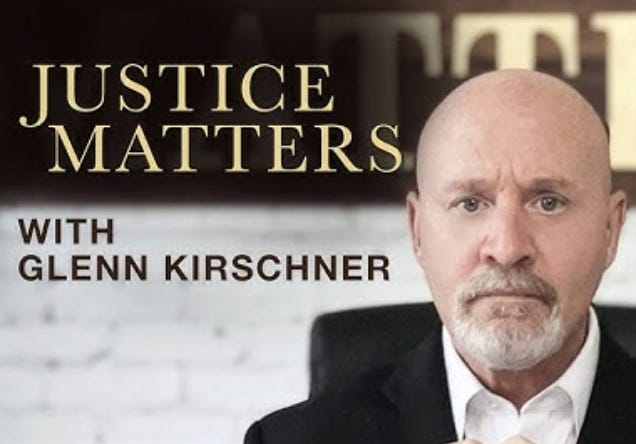
Glenn Kirschner Bio:
Glenn Kirschner brings analysis and insight to legal issues of the day, drawing from his 30 years as a federal prosecutor, homicide prosecutor and Army JAG. After spending more than 6 years as an on-air Legal Analyst for NBC News and MSNBC, Glenn decided to leave corporate media and be 100% independent in all his professional endeavors
Transcript - Simon Rosenberg and Glenn Kirschner (1/20/26)
Simon Rosenberg:
Welcome, everyone. Simon Rosenberg, Hopium Chronicles, back with one of my favorite guests, Glenn Kirshner. Glenn, welcome. Thanks for coming back.
Glenn Kirschner:
Happy to be here, Simon.
Simon:
So, Justice Matters, legal commentator, you know, somebody who's really in these last few years during this crazy era of Trump, really has helped us understand how this is evolving. And I'm just grateful for your terrific and informative commentary. I'm a big fan, so it's always great to have you here. I want to talk today about something that I've been writing about. There's so much to talk about. But in the last few weeks, Trump, they made a decision, I think at the end of the year. That this Trump thing wasn't going the way they wanted. And that his poll numbers were down, the Supreme Court had just ruled against them about having troops in the street, his health is not doing so well. He had been stymied domestically by federalism and by the courts. And the economy wasn't working. And I think they made a decision to sort of come out of the box in 2026 roaring, in Minnesota, in Venezuela, in Greenland, right? And that there's been this dramatic escalation in the last few weeks.
But at the core of it has been something that I've been really struck by that I feel is part of this escalation, which is that Stephen Miller, which we're going to show this clip in a second, went on TV and asserted that we now live in essence in the law of the jungle and not the rule of law. And we'll listen to his own words in a minute. And that the president then gave an interview for the New York Times where he said, the only check on his power was in his own mind. And it's like out of a Monty Python movie, right? It's so absurd… and then J.D. Vance came out and said that they believe in absolute immunity for ICE agents, which is a concept that seems completely at odds with how any democracy would work. And I just wondered if you have sort of seen an escalation in their rhetoric about their relationship to the rule of law? Because it certainly seems to me that we're entering a new place in their understanding of where that all is.
Glenn:
Certainly there has been a shift in their rhetoric, but I don't know that I've seen a shift in their conduct. We have to go back to the first day of his second term when somebody slid the Constitution under his nose, a document I would still bet he's never read, and he picked up a black sharpie and tried to cross out of the constitution the birthright citizenship guarantee. And it was I believe three days later on January 23rd when a Ronald Reagan appointed federal judge said what trump did was quote blatantly unconstitutional. Blatantly and obviously unconstitutional. But but then they doubled down and tripled down. And their behavior has been lawless and unconstitutional from day one in many respects, but I agree with you Simon. The rhetoric now is that they apparently are trying to peddle to the American people in the world that the laws don't apply to them. And I assume that also means the Constitution doesn't apply to them, because that's certainly the way we see Donald Trump's federal law enforcement agents behaving in Minneapolis and elsewhere. And we can talk about what might be behind that, what might be inspiring the kind of, you know, transparent lawlessness that we see in American cities, you know, it feels like the ICE agents may know that they're not necessarily above the law, but they are protected. And we can talk about some data points to signal that.
Simon:
Well, let's roll this clip from Stephen Miller, because I think if you haven't seen this, everybody… it's going to take about a minute or so.
From The Video:
Stephen Miller: “What the president said is true. The United States of America is running Venezuela. By definition, that's true. Jake, we live in a law, or sorry, we live in a world in which you can talk all you want about international niceties and everything else, but we live in a world, in the real world, Jake, that is governed by strength, that is governed by force, that is governed by power. These are the iron laws of the world that have existed since the beginning of time.”
Simon:
So you heard him say it, right? It is an assertion that the rule of law doesn't apply. That there's this other rule, he called it the ironclad rule in history, that it's force and strength, which is obviously the exact opposite of the whole theory of the founding of the United States.
Glenn:
Yeah, this is a variation on the theme might makes right. To the victors go the spoils. The ends justify the means. You know, I don't think there are many folks who would agree with any of those propositions. And certainly, you know, not the basis for the founding of our nation. It is not what our constitution stands for. Allegiance to the rule of law, you know, an oath to support and defend the constitution against all enemies, foreign and domestic. And we have, you know, sort of the pinnacle of the domestic enemy in the oval office right now. But this is, I think, Trump and Stephen Miller's attempt to flood the zone with so much lawlessness that we can't seem to wrap our hands around any one thing that will galvanize us and, you know, urge the kind of opposition that we need to rise up peacefully and work toward dethroning this de facto dictator.
Simon:
You know, today, Gavin Newsom in Davos… I showed it on Hopium earlier today. And Lincoln, we should have teed it up. I forgot about it. But he talks about how Trump is, you know, is so forceful and fighting. And he said, it is now the law of the jungle. It is the law of Don. Globally… this illegal seizing of Greenland…
The way I've written about this, Glenn, is that Trump really seems to believe now that the Constitution, US law, the UN charter, the international law, and the Senate ratified treaties do not apply to him. And the reason I'm pushing this… I think that the notion that you could imagine that all of these laws exist, and they have been passed by Congress, and signed even in some cases by him, right? These are laws that he's signed since he's been in office and that they're recommendations, they're options, or that you can just walk away from treaties that we have with other nations.
It's an incredible moment in our history where he's washing away not just 250 years of jurisprudence here, you know, 250 years of our own system, but an entire global rules-based order that was founded by our country, that was imagined and created by our country, that has created a period of unprecedented peace and prosperity in human history. And he's just decided that it doesn't apply to him.
Glenn:
And, you know, I guess maybe, Simon, we could have envisioned, if not a madman in the Oval Office, a malignant narcissist. A lot of data points suggesting that that's what Donald Trump is, a sadist. He enjoys the suffering of others. Lots of data points to support that, coupled with dementia, because it looks like his mental health is in decline. So maybe we could have envisioned that. The one thing I never envisioned and still can't accept or explain is how a whole political party, you know, maybe but for the Adam Kinzinger's and the Liz Cheney's have decided that they're willing to sacrifice everything, including their own constituents who put them in office to this madman and this unhinged behavior. Now, I still believe that this is not sustainable one way or another.
Donald Trump will fall from political power, in my humble opinion. I am no political expert or pundit. I've never played one on TV, but I don't think this is sustainable. I don't know what that means. But this is so unhinged and out of control that he's declared himself the acting president of Venezuela and that he now said that there's no going back on the United States taking Greenland one way or another. And as you mentioned in your opening, he said the only thing that constrains me is not the law not the constitution –– it's my own mind and my own morality. There is absolutely no constraint whatsoever. This isn't sustainable, Simon.
Simon:
When I describe the “in my own mind” thing, I don't even bring up my own morality because it's so comical that I can't even… I feel like people won't believe me if I said that's what he said… but the other thing that he's done, by the way, in terms of lawlessness and sort of perversion, is that he's essentially taken over Gaza. He's created this corrupt board and it's like a rogues’ gallery. So he's now running Gaza and building it into sort of a gated community over there where everyone's going to be able to build their own little communities. He's anointed himself sort of, I call it the emperor of the Western Hemisphere and high lord of the Americas, and Venezuela and Greenland, and what's interesting when you talk about him falling… and we're going to have Rob Shapiro come on tomorrow to talk to us, the economist, the Europeans now are openly now talking about getting out of U.S. Treasuries. Denmark announced today they were exiting U.S. Treasuries. And this could create, you know, if this is real, and this is where Trump in his idiocy, you know, he doesn't do homework and he doesn't really understand how this stuff works… this could create an enormous financial crisis in the United States if the Europeans follow through on this.
And so to your point, his power is imaginary. His understanding, I think, of what made America powerful and strong is incorrect. We're in a very bumpy period globally. The Europeans are very, very, very angry and feel very betrayed. And today the speech that the European president gave yesterday was a speech where she declared independence from the United States and it's sort of the ending of this 80-year transatlantic alliance that we had. Sort of a very dramatic moment. And all predicated from this notion that Trump doesn't believe that he has to fall within the system that he inherited, by the way, that he ran for. He ran to be president of the United States. He didn't argue that he was going to be dictator of the world, and he's decided to abandon that system that has been in place now for 80 years.
Glenn:
The only question is, what do we do about it? What does Congress do about it? And, you know, what do other nations do about it? And it seems to me that, you know, the collective power of the people and of the Congress, absent the Republican Party at the moment, and NATO nations, for example, is a heck of a lot greater than Donald Trump.
And I've been saying for a long time… I was an active duty army JAG prosecutor for six and a half years before I joined the Department of Justice… I've been saying for a long time that given the way things are going and Trump is behaving, it may all boil down to whether the United States military decides to abide by its oath to support and defend the Constitution or decides to fall in with an autocrat, an aspiring dictator. If they decide to fall in with the dictator, then I think not only the United States, but potentially the world, is in trouble. If they take seriously their oath of military office, then I think ultimately we're going to be fine because he's not going to be able to lawlessly invade and seize foreign countries who are allies. But that's what it may all boil down to…
Simon:
There’s a big difference between snatching Maduro in an overnight raid and trying to take possession of a NATO ally and a lot of land. I want to come back to something you mentioned earlier, Glenn, and I'm just grateful for you kind of rolling with this today. We have this amazing statement made today by a group of police chiefs in the Minneapolis, in the Twin Cities area. And Lincoln, if we can roll this and we'll come back, Glenn, and talk about this on the other side.
From the Video:
Police Chief Mark Bruley: Good morning, everyone. I'm Mark Bruley, police chief of the City of Brooklyn Park. Behind me is a bunch of amazing police chiefs that are here in support of a very short, but very important message that we want to share with you. What you won't hear from any of us today is rhetoric of abolish ICE or that there shouldn't be immigration enforcement. The truth is immigration enforcement is necessary for national security and for local security. But how it's done is extremely important. In fact, we have a long history of working exceptionally well with our federal partners, including ICE agents. And we have seen the best of them perform their job extremely well in the past. With that said, as recently as the last two weeks, we as law enforcement community have been receiving endless complaints about civil rights violations in our streets from U.S. citizens. What we're hearing is they're being stopped in traffic stops or on the street with no cause and being forced to demand paperwork to determine if they are here legally. As this went on over the past two weeks, we started hearing from our police officers the same complaints as they fell victim to this while off duty.”
The chief continues: “Every one of these individuals is a person of color who has had this happen to them. In Brooklyn Park, one particular officer that shared her story with me was stopped as she passed ICE going down the roadway. When they boxed her in, they demanded her paperwork, of which she's a U.S. citizen and clearly would not have any paperwork. When she became concerned about the rhetoric and the way she was being treated, she pulled out her phone, and in an attempt to record the incident, the phone was knocked out of her hands, preventing her from recording it. The officer had their guns drawn during this interaction. And after the officer became so concerned, they were forced to identify themselves as a Brooklyn Park police officer in hopes of slowing the incident and deescalating the incident down. The agents then immediately left after hearing this, making no other comments, no other apologies, just got in their vehicles and left. I wish I could tell you that this was an isolated incident. In fact, many of the chiefs standing behind me have had similar incidents with their off-duty officers. This isn't just important because it happened to off-duty police officers, but what it did do… is we know that our officers know what the Constitution is, they know what right and wrong is, and they know when people are being targeted, and that's what they were. If it is happening to our officers, it pains me to think of how many of our community members are falling victim to this every day. It has to stop.
Simon:
Amazing. Talk to us, Glenn, about your understanding of what should be happening here and how the laws are being broken. I mean, I went back and read the Fourth Amendment, you know, I'm not a lawyer, and I was really struck by the clear language about the need for warrants and probable cause. And so can you talk a little bit about that?
Glenn:
Yeah, let's drill down a little bit on what we just heard Chief of Police Bruley say and the two ways ICE agents violated the law. And the victim happened to be a Minnesota police officer. And I've wondered aloud, often, over probably the entire first year of Donald Trump's term, when the states would begin to assert themselves and protect their own residents, the people within their state borders, from crimes being committed by masked federal officers.
But let's go to the basics. So the Fourth Amendment happens to be my favorite amendment. The right of the people to be secure in their persons, houses, papers and effects against unreasonable searches and seizures shall not be violated, shall not. Seizure is a fancy word, Simon, for the police stopping you in your car, the police trying to open your car door or telling you to get out of the car. That's a seizure. There are other kinds of seizures like when you shoot someone, that's a seizure. When you put your knee on their back or their neck, that's a seizure. And there has to be the requisite evidence that can be proved ultimately in a court to satisfy the Fourth Amendment's prohibition against an unreasonable search and seizure.
What Chief Bruley just described there, Simon, is both a crime in violation of Minnesota state law and the violation of the Fourth Amendment. So first of all, when you grab the cell phone out of somebody's hand, that's an assault. It could also potentially be a robbery. It's an assault… it doesn't have to result in injury. That violates Minnesota state law and virtually the law of all 50 states. When you see somebody without reasonable, articulable suspicion that they've committed a crime, there has to be evidence of that. you have violated their Fourth Amendment right against an unreasonable seizure. So those ICE agents violated both the state law and the Constitution. What are the local police going to do about it? If it were me… I was a career prosecutor 30 years, both in the army as a JAG and at the DOJ for 24 years, specifically the DC US Attorney's Office. You know, you need to hold federal officers accountable for committing crimes in your state if you're a state law enforcement authority.
But here's the thing. I believe Donald Trump wants to inspire this friction between state law enforcement authorities and his federal agents. Why? Because that will create more chaos. You know, I mean, it sort of moves us in the direction of a potential civil war. Let's not go there. It creates the kind of chaos that Donald Trump will then use as a pretext to do what? Invoke the Insurrection Act because he can't enforce the federal laws. So what happened to states' rights, by the way? Didn't that used to be a Republican priority? So I think this is exactly what Donald Trump is trying to do… and don't take it from me. Take it from the words of Judge April Perry, who, you know, presided over the case involving Trump's attempt to federalize and deploy to Chicago the Illinois National Guard. And Judge Perry said Donald Trump is pouring fuel on a fire he started. He knows what he's doing. Or those around him know what they're doing. I'm not entirely sure he knows everything that that is going on in his own administration, but this is what they want. Because they want to ratchet up both the violence and the federal response to that violence. And ultimately, I think his goal is probably to interfere with the midterm elections and maybe try to find a way to cancel them, though he can't do it legitimately and lawfully. But as we know, he doesn't care about acting legitimately or lawfully.
Simon:
You know, in my commentary, what I have been talking about in Minnesota is the need to restore rule of law. Because I think that unless you hear Glenn or someone like Glenn explain how fundamentally lawless this really all is… you know, and we've seen the videos, right, of them breaking through windshields. I mean, there have been a couple of things to me that have been the most jarring. And one of them is the ease in which they break windshields in cars. You know, you can see video after video. It's like the equivalent of them breathing, right? They have no recourse, no hesitancy. They just break windows and drag people out of cars. And as you pointed out, it's a wild violation of you know, fundamental rights in this country.
The other thing, other than all the obvious stuff that we're seeing, that has been shocking to me is that last week, I saw a bunch of people in one of these videos standing on a street corner, Glenn. Essentially bystanders. They weren't protesting… they're in neighborhoods. People in the neighborhood are gathering to sort of see what's going on. A bunch of ICE agents basically ran through them, knocked a bunch of the people to the ground, pushed, shoved them down. And it was an assault on people. And they had their back to them, right? Like they didn't even know they were coming. And I was like, what in the world? I mean, there's this sense of impunity… that they can just knock over clearly innocent bystanders who are getting in their way with such thuggish behavior, which means that they're being told… and this gets back to this absolute immunity thing… that they can do whatever they want and they're going to be fine. And you had some thoughts about how you think we got to this place…
Glenn:
So first of all, part of the problem, Simon, in what you just described is if state law enforcement agents allow these masked federal officers to assault the citizenry of the state with impunity… because it doesn't even look like they need absolute immunity, which they don't have. We'll get there in a minute. But they kind of have de facto immunity if state law enforcement officers are not going to address assaults that are being perpetrated every day in their city. That's a real problem. When we talk about absolute immunity, of course, JD Vance is not stupid enough to believe officers actually have some legally cognizable absolute immunity. They don't. They have qualified immunity if they're acting within the scope of their official duties, and if it's necessary and proper to exercise force, then they probably can't be prosecuted for that. But within the scope of their duties - and necessary and proper - are kind of important legal concepts.
You don't get to shoot an unarmed motorist, you know, three times when she was obviously not armed, doing nothing illegal, trying to, by all accounts, turn her wheels to the right to maneuver around a vehicle that was stopped in the middle of the street. And even before that, you can see her waving on another vehicle saying, go first. And her last words were telling Jonathan Ross, dude, “I'm not mad at you.” And Jonathan Ross last words that seem to be captured on his cell phone is, you know, f****** bitch, assuming that's his voice, it would have to be authenticated. But local authorities have to have to address that. And we can talk more about what may happen in the Renee Good matter moving forward.
But here's my problem on the absolute immunity front. No, there's no such thing in the law as absolute immunity; however, if as the Department of Justice, you abdicate your, quote, solemn duty… I'm quoting the former chief of the Civil Rights Division at the Department of Justice, Kristen Clarke, who said, we have a solemn duty to investigate officer-involved fatal shootings… if you abdicate that responsibility, that solemn duty, what are you doing, Simon? You're sending the message to all federal agents that you got a license to kill. Have at it, right? The other thing that would be de facto absolute immunity, not as a legal concept or doctrine, but in practice… and I just talked with Liz Oyer about this not long before jumping on with you today, the former pardon attorney and before that 10 year federal public defender… you know, I said, Liz, is it possible that Donald Trump has promised or maybe already pre-printed pardons for his entire ICE force, for his entire executive branch? And she had to, I think, reluctantly acknowledge that's a possibility. So what does that do? It grants de facto absolute immunity for officers to engage in lawlessness.
And that, to me, is at least one explanation for why we see the willingness, as you just described, of federal officers to commit crimes on video. Multiple citizens out there with their cell phone videos capturing evidence of assaults and violations of constitutional rights every damn day. Well, if these folks already know that they are de facto immunized, That may account for why they just don't care that they're being caught, that there's strong evidence that they are violating state laws and the Constitution.
Simon:
You know, the abuse of the pardon power by Trump… it's been staggering. And for the Supreme Court to have granted him some version of immunity from prosecution, and then him having the power to immunize others illicitly… is a double whammy, right? And this is why what the Supreme Court did was so extraordinarily pernicious because it was in a political system where our chief executive has this kind of unlimited pardon power. And so the Supreme Court, by doing what you described, by giving him immunity, essentially created the condition where he can create immunity for thousands and thousands of criminals committing crimes, which is what we may be seeing right now.
And it's sort of hard to believe in our society… and how based we are in rule of law and how fundamental that is to any understanding of the United States, right? Because we didn't have a different regime one day. The United States has only had one manifestation. And that's as a democracy and a global champion for human rights and human liberties. And so the Supreme Court's decision to create this immunity for him was potentially world-altering for us in this country domestically, and it makes it all that much more shocking in hindsight.
Glenn:
I love talking about the case, the presidential immunity case, which is captioned Trump versus United States. And if ever there was an appropriate caption for what we're going through, it is Trump versus the United States.
It's a horrific ruling. It is contrary to the express language of the Constitution. The president is obligated constitutionally to take care that the laws of the nation be faithfully executed. Simon, that's the exact opposite of the Supreme Court saying the president can violate all of our nation's laws, victimize, you know, wide swaths of the American people. And he cannot be held accountable in a court of law. He has absolute immunity for it. That's the opposite of the Take Care Clause. It also happens to be the opposite of the Impeachment Judgment Clause, which says a president can be anybody, but a president can be impeached by the House, tried, convicted and removed by the Senate. And he can still be prosecuted. How does that translate into he can't be prosecuted for his crime? So this was a political opinion by the six justice majority, not a legal opinion, in my view. But all of that being said, I love talking about it because it ain't over, not by a long shot, because what they did… they didn't say he's just got absolute immunity. They broke it into three categories.
They said, one, for core constitutional functions, like directing the military, unfortunately, he has absolute immunity. But for any other acts that are not core constitutional functions but may be within the scope of his official duties, he has a rebuttable presumption of immunity that prosecutors can use evidence to rebut and prosecute him if they can rebut the presumption. And the third category, most importantly, is private conduct enjoys zero immunity. Simon, where were we at the time of the election? Where were we right before Donald Trump got elected? We were litigating in federal court in front of Tanya Chutkan. The question of which of the four felony counts for which Donald Trump was indicted at that moment… which of those four felony counts could continue to trial because they didn't enjoy presidential immunity? And I believe, to my core, Judge Chutkan would have ruled all four survive the presidential immunity ruling because, you know, launching an attack on the capitol as a candidate who desperately didn't want to relinquish power… wanted to steal an election… that's neither a core constitutional function, nor is it an official act that would enjoy presumptive immunity. It was the private act of a candidate. We were heading in the direction of a criminal trial. We were also heading in the direction of a criminal trial in the classified documents case, which was on appeal in the 11th Circuit Court of Appeals. And they would have overturned Judge Aileen Cannon's dismissal on that insane claim that special counsel just ain't a thing… I'm translating legalese to English there.
So it's not over. Those two cases are not dead and buried. Both of those cases, Simon, when the law comes back into the light of day, and we are fighting every day to make sure it does, we'll get back into court. When I say “we,” I'm a career prosecutor, it's the royal we. [Simon laughs.] Well, listen, I would be back in government today if Kamala Harris had been elected. And I hope to go back to government someday and be part of the solution and the reform and the rebuilding project. But we go back to court. We rebring those cases, which were dismissed without prejudice, which means you can rebring them. We're going to have to fight the statute of limitations battle, but I could do a whole law school class on why I think we should win that battle. And then we're back in the business of trying to hold Donald Trump accountable for those and so many other crimes. So, it's not over. It's not all darkness. Yes, we're living amidst the Trump induced darkness, but there's a whole bunch of points of light out there. We focus less on them and corporate media certainly focuses less on them because I don't think they're as click worthy as focusing on the bad stuff. But we're not done. We're not done.
Simon:
It's a very Hopium way to end, Glenn, and next time you come back I want to talk to you about… given the way that you just ended… how we think about his corruption. Which has now become a central activity of the administration, of him, you know, this corruption machine that he's building. Or him taking the oil money and putting it into an offshore account in Qatar. I mean, I think that we have to start thinking through, as you've already done, about what cases can be brought that have reasonable chances of escaping the absolute immunity. The plunder piece of this needs… I think, we need to be starting to air out publicly sort of the legal rationale of prosecution around the plunder and the selling of pardons and all that stuff… because that stuff is so pernicious and so unprecedented and so ghastly that we have to attack that at some point in order to disincentivize for that to ever happen again. And so, you ended on a great note but I want to give you a homework assignment… I'd love to have you back in a few weeks to talk about strategic theory about how to prosecute the plunder. Something I'm really interested in.
Glenn:
There are ways to do it.
Simon:
Well, we need to start airing this stuff out because this is, you know, until the elections in 2026 and 2028, our solemn… I'll use the term you used… our solemn obligation is to weaken the regime. And I think that no one's really gone after him, you know, yet. And I think the question is whether or not we need to start creating some conditions where we start going after him on things that will be very hard for him to defend. And obviously they can drag stuff out and everything else, but we have to open up more fronts in my view against him. And, you know, we haven't really taken direct shots at him legally. I think the corruption stuff… we know from polling that this stuff is a serious problem for voters. This is a big, big problem. So we'll come back in a few weeks, Glenn.
Glenn, how do people find you?
Glenn:
So, you know, I'm really enjoying Substack these days because, look, I've got my YouTube channel. I've been up and running for six years now, Justice Matters with Glenn Kirshner. I do a daily legal analysis video and over the last year on Substack we have built a community. We actually have community meetings at 8:30 PM Eastern time every night where we talk about the rule of law. And I think I need those meetings more than the people who join live. But it is a great place to find community, to find information, to find independent news and analysis because independent media is the wave of the present, not the wave of the future. So come join us over on Substack. I don't put anything behind a paywall. I don't believe in it. Not one word, not one video. You're welcome to support my all volunteer efforts if you want, but you don't have to to get my content. So come on over for free. Enjoy our community meetings nightly and see what you think.
Simon:
So, you know, all of my Hopium content at Hopium, there’s no paywall. As you know, Substack doesn't really like that, by the way. [Laughs.] They like paywalls. It's how they make money, right? And so you and I are in the Substack doghouse because we don't use paywalls enough. But I agree with you about the theory of that. And we have a community meeting once a week. I can't do it five nights a week. God bless you, Glenn, for that.
And listen, thank you. I just want to finish by saying, you know, this has been so crazy, and there have been voices and commentators that I have come to really rely on that have been grounding for me. And you've been one of them. And so thank you so much for, you know, your integrity and your insights, and also your ambition in communicating. I think that's the other thing I want to say is that you've been aggressive about bringing this stuff to people. And I've just really been grateful for that. So thank you. And go check out Glenn's Substack. Go subscribe to his YouTube channel. It's now one of the OGs out there in this modern age. And Glenn, just thank you for everything.
Glenn:
Thank you, and thank you for giving me my Hopium fix because I watch your content all the time, Simon.


