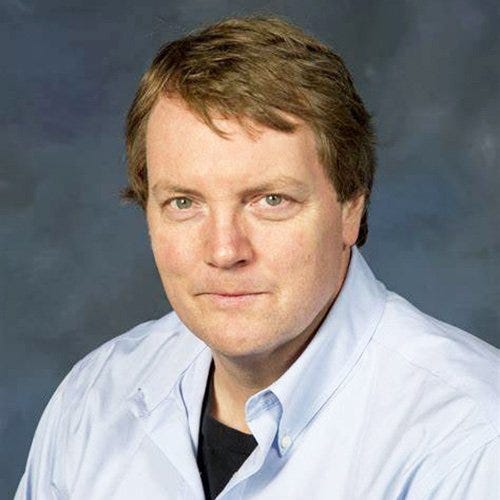
Greetings all. We’ve been talking a lot about Ukraine and Iran this week (here, here, here, here), and am excited to share an incredibly informative conversation I had this afternoon with Dr. Phillips O’Brien, professor, historian, author, and fellow Substacker. You can find a video and transcript of our discussion above, and Dr. O’Brien’s bio below.
I asked Dr. O’Brien to come by to talk to us about a terrific new article he just published on his Substack, Taking The “Initiative” In War Might Not Be What You Have Been Told. Here is some of what he said:
What's going on with Ukraine and the Ukraine-Russia war is that the Ukrainians adapted, and they adapted really well, beginning in 2025. A lot of people were saying to them they should draft people. They should send them to the front, they should have more infantry up on the front line.
And the Ukrainians said, that's not right. We're looking at our war, and what we see is actually the front is just getting more and more dangerous. I mean, it's a horrible place to fight, because as soon as you go out, you're going to be seen. As soon as you're out in the open, you're going to be seen. And what the Ukrainians have done is they have adjusted. They've taken tons of troops from the front line. They're fighting mostly with drones and even now these unmanned ground vehicles, UGVs… you might think of small tanks with no people on them.
The Russians are just not moving forward. I mean, they can't move forward in this war like they were in 2025. So that's the ground war. In the range war for Ukraine, another good story is developing. [Ukraine] has developed a whole bunch of new long-range systems, and they've stretched Russian air defense, and they're able to hit targets 1,500 kilometers, 1,000 miles, from Ukraine in Russia. And the Russians are having trouble defending them.
More:
Trump will never like Zelenskyy. He hates Zelenskyy. Trump will never support Ukraine. All we're seeing is Trump obviously getting intelligence that Ukraine's doing well, and therefore he doesn't want to be caught out, I think, by what's going on.
What Zelenskyy did in the last two months in particular is start saying the truth. And the truth is, the United States is not on our side. We cannot trust Trump. We have to look out for ourselves with our European friends, and that's our future. Speaking with such clarity on that issue took a lot of people's breath away. I think they were not expecting him to be as open about Trump being completely untrustworthy as he has been. But in speaking honestly like that, he's actually wrong-footed the administration. The administration doesn't know how to deal with him now because they're used to people who lie and people who suck up to Trump. And Zelenskyy just stopped that. So you could say his last few months have been a textbook in international affairs handling.
Dr. O’Brien went into greater depth about the importance of Zelenskyy now telling the truth about Trump in this recent Atlantic article, Ukraine Has Finally Given Up on Trump (gift link, strongly recommend).
Here’s what he Dr. O’Brien said about the importance of “Initiative” in understanding war:
It was to talk about war and what's going on in the Ukraine war. I wrote the piece, and it was partly because I don't think people understand how to judge what is going on in a war.
And particularly, a lot of the analysis has been really poor, because it's all been about, "Well, who's made the most recent advances? If you make some advances, you're winning the battles, and therefore you're winning the war." That's the way Trump, by the way, portrayed the war… throughout 2025, Trump portrayed the war as this Russian steamroller. It wasn't moving fast, but it was gobbling up little bits of Ukrainian territory and was unstoppable. And what I tried to say is, that's not initiative. What the Russians were doing is simply what they had been doing. They weren't changing.
Initiative is shaping a war to your advantage. It's looking at it. It's making the right choices. And in many ways, it's actually being defensive in the right way… to such a degree that you can blunt the other side. So don't think about war as, "We've got to win the big battle, the Ukrainians have to start attacking, to go on the initiative, to go after the Russians." What they have to do is destroy the Russian war machine…
There is so much in here to chew on and I strongly recommend getting to it as soon as you can. Trump and Putin have stumbled, and it is critical that pro-democracy forces here in the US take advantage of their struggles - “take the initiative” - in the months ahead.
Keep working hard all, and I am grateful every day for being able to be in this fight with all of you - Simon
Biography - Dr. Phillips P. O’Brien
Phillips Payson O’Brien is a Professor of Strategic Studies at the University of St Andrews in Fife, Scotland. Born and raised in Boston, he graduated from Trinity College in Hartford, Connecticut before working on Wall Street for two years. He earned a PhD in British and American politics and naval policy before being selected as Cambridge University’s Mellon Research Fellow in American History, and a Drapers Research Fellow at Pembroke College. Formerly at the University of Glasgow, he moved to St Andrews in 2016.
At St Andrews, O’Brien is chair of the School of International Relations. He has published widely on issues of conflict, politics, war, and strategy in the twentieth and twenty-first centuries. Among his books are How the War Was Won: Air-Sea Power and Allied Victory in World War II (Cambridge University Press, 2015), The Second Most Powerful Man in the World: The Life of Admiral William D. Leahy, FDR’s Chief of Staff (Penguin Random House, 2015), and his most recent publication, War and Power: Who Wins Wars — And Why.
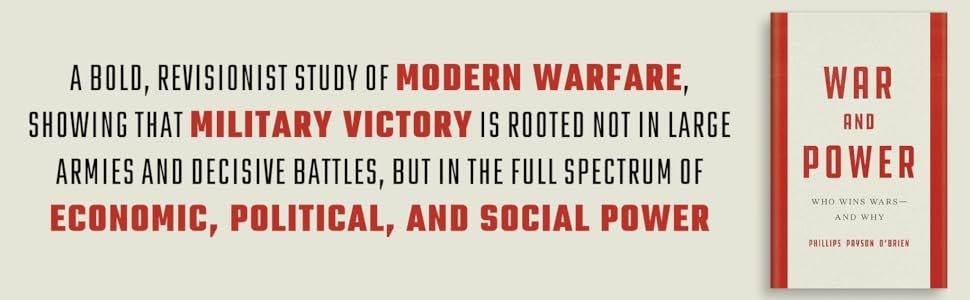
Dr. O’Brien has also published multiple articles in major journals including Foreign Affairs, Diplomatic History, the Journal of Strategic Studies, and Past & Present. He has worked with scholars and analysts in Ukraine, throughout the rest of Europe, and across the Atlantic to try and digest some of the lessons of the war and to understand why the prewar analysis was so fundamentally flawed. His commentary has been published regularly in The Atlantic, The Times, The Spectator, The Telegraph, and other major newspapers and journals.